Tuesday, July 21, 2015

Much Ado About Nothing


   The title of this Shakespeare play actually sounds better in Hebrew than in English: Rov Mehuma Al Lo Me’uma (רוב מהומה על לא מאומה), and it summarizes the latest rabbinical “scandal” eagerly reported in a New York Times “expose” and just as eagerly picked up by The Jewish Week.  It was reported that Jonathan Rosenblatt, the rabbi of long standing at Riverdale Jewish Center, a prominent Orthodox synagogue in the Bronx, had played squash and racquetball with young male congregants, then showered with them naked (that’s how men usually shower) and sat with them in a sauna or steam room, naked or wrapped in a robe (as men usually are when they use saunas and steam rooms).  This had gone on for decades and reporters at both publications had known about it for decades, but did not report it until now because only now was one person man enough to speak for attribution.  Plenty of others were ready to bad-mouth the rabbi, but only behind a veil of anonymity.
 
   Among the words used to describe Rabbi Rosenblatt’s conduct are “disturbing,” “inappropriate,” “unusual,” and words of that ilk.  Never “illegal” or “criminal.”  By all accounts there was no sexual touching or other sexual misconduct, as occurred in other well-publicized sex scandals involving rabbis.  The New York Times article itself states that “parsing [the rabbi’s conduct] is an exercise in ambiguity.”  If so, and given Rabbi Rosenblatt’s stature, are we not required to be דן לכף זכות, to give the rabbi the benefit of the doubt?
 
  Up until the middle of the 19th century it was unusual for any observant Jew to play organized sports.  Then Jewish consciousness began to be raised by the Zionist movement and men such as Max Nordau.  Young Jewish men, first secular and then observant, began seeing their bodies and minds as an integrated whole, each feeding off the other.  Orthodox rabbis, however, remained the black-suited, black-hatted purveyors of scholarship and dared not step out of that realm, except maybe to escort congregants to Soviet Jewry demonstrations or Salute to Israel (now Celebrate Israel) parades.  Rabbi Rosenblatt, it seems, was the first to think and act outside of that box, and more power to him.  Several years ago the chief rabbi of Warsaw was attacked and beaten by anti-Semitic Polish hoodlums.  Just imagine if he had been able to give those goons a proper rabbinical butt whooping.  It would have been a tremendous kiddush Hashem, a veritable earthquake, with aftershocks rippling with his muscles through the length and breadth of Poland.  No more would the few Jews left in Poland be seen as easy marks.
 
   One of the anonymous complaints concerned the rabbi lingering in a post-workout shower with the boys and young men with whom he was bonding; there was no rush.  Why should there have been a rush?  Were they expecting a trainload of Jews arriving and having to use the shower?  A shower after a hard fulfilling workout may be routine for others who take their physicality for granted, but for us it is a mystical experience of supernal joy.  That’s water coming out of those shower heads, not gas.  We draw water with joy from the wells of salvation (see Is. 12:3).  Take as long as you want.  Sing, whoop and holler if you feel like it.  Savor the experience as you would good wine.  I remember running races in the summer heat and makeshift showers would be set up along the course.  I’d pump my fist in the air, run through and shout “l’chaim” – to life.  Who needs drugs when you can get high on pure Jewish joy?  It is said that at the entrance to the gas chamber at Auschwitz hung a sign reading  זה השער לה' צדיקים יבאו בו  - This is the gate of the Lord; the righteous shall enter it (Ps. 118:20).  Perhaps the showers of gyms at yeshivot and Jewish community centers should have signs reading יבואו בו זה השער לגאולה חזקיםThis is the gate of redemption; the strong shall enter it.  I remember taking showers in school after gym or swimming, naked with my classmates in full view of one another, and thinking nothing of it.  I don’t remember if the teachers showered with us, but if they had it would have been no big deal.
 
   The person who apparently was leading the charge against Rabbi Rosenblatt is female and, not surprisingly, knows nothing about male bonding and male fellowship.   She does not understand why the rabbi “didn’t get”  his alleged judgment error.  Actually, it is she that “doesn’t get it.”  We men need to be with one another where females are absent, to be “out with the boys.”   Time was when construction workers, longshoremen (those brawny fellows who unloaded ships before modern containerization) and such working in Lower Manhattan would, after a hard day’s work, repair to McSorley’s Ale House and enjoy some salty man talk in one another’s company over a pint or two.  No more.  Since 1970 McSorley’s must, per court order, be open to women.  In Russia, Eastern Europe and Turkey the steam bath (and in Scandinavia the sauna) filled the role of McSorley’s.  Jewish men coming here from that part of the world brought the “shvitz” culture with them, and passed it on to their progeny.  So here we have an Orthodox rabbi who worked out with boys and young men, then showered and spent time in the steam room or sauna with them, discussing matters of faith and philosophy in a relaxed atmosphere where they could let their guard down.  Why would any man or boy get uptight over it?  Mothers did, and that is understandable.  Among other functions, these male-only get-togethers removed boys, if only temporarily, from the influence of their overbearing Jewish mothers, taking them out of the world of women and into the world of men.  That can be traumatic for women who can’t let go of their little darlings, but for their sons it is liberating and healthy.
 
   To be sure, there were minor errors in judgment.  Most of them stem from not adhering to a fundamental part of the masculine mystique in America, dating from the Old West, that exhorts us to never say behind a man’s back what you would not say to his face.  Interestingly, this echoes a saying of one of the European ba’alei mussar of the late 19th and early 20th centuries: Don’t talk about people; talk to them.  In Israel men are expected to “talk dugri,” i.e. direct and to the point.  Some of the young men were uncomfortable with the rabbi’s style, or so they told reporters years or decades later.  With the passage of time, memory can play tricks, but it is perfectly reasonable that some people would be uncomfortable.  In modern societies (but it would seem not in the primitive ones that renowned anthropologist  Margaret Mead visited) puberty and adolescence is characterized by a great deal of Sturm und Drang.  Young people are prone to read into situations what is not necessarily there.  What one person experiences as a glance, or even thinks nothing of, can be experienced by someone else as gawking.  When I was in high school, a male biology teacher once remarked to a classmate, “those biceps [mine] are unreal.”  Having been lifting weights for several years,  I took it as a compliment, large biceps still being unusual in American yeshiva boys in the 1960s.  Given the anxieties teenage boys experience about their sexuality, anxieties not addressed by the limudei kodesh teachers (only one specific act is Biblically prohibited), some other boy might have experienced the same remark as “creepy.”  The boys and young men who were uncomfortable with nudity in the shower and/or steam room should have simply told the rabbi.  Alternatively, they could have asked him if this was appropriate behavior for a rabbi, perhaps citing sources if they could.  It could have opened the door to some interesting and healthy conversation.  One student recalled getting sick in yeshiva and being driven home by the rabbi, with pleasant conversation in the car.  When they arrived at the student’s home (the parents were not present), the rabbi suggested the boy might be more comfortable if he changed into a bathrobe.  This was not far-fetched; yeshiva clothes can be distinctly uncomfortable, especially when one is not feeling well to begin with.  The boy did not want to change, and told the rabbi.  According to the boy’s recollection, the rabbi stayed in the student’s house (is there any yihud issue between two males?) and persisted in trying to get the boy to change.  With 20/20 hindsight I understand and sympathize with the boy feeling put in an awkward spot.  Some of the people involved were so put off that they chose another synagogue to attend.  This too is nothing out of the ordinary; in any community where there is a choice of synagogues congregants come and congregants go.  Leaving is the best solution when a personality clash between congregant and rabbi is so deep that remaining together becomes untenable.  Others, however, benefited a good deal from those encounters and are appalled that the rabbi, to their way of thinking, became the object of a malicious smear campaign (lashon ha-ra) years later.  Students in Yeshiva University kept coming, of their own volition, to do rabbinic internships with him even when the university stopped sending students his way due to complaints, some of which were justified.  The power relationships between rabbi and intern could create the appearance that the scantily clad shvitz sessions were necessary for the intern’s career advancement.  Similar situations could occur between professors and undergraduate or graduate students at a secular university; today professors assiduously avoid any interaction that can give any such appearance.
 
   The entire matter seems to have been resolved to most everybody’s satisfaction.  The rabbi will be staying out the few years remaining on his contract.  This resolution was reached after a frank exchange between rabbi and congregants, accompanied according to press reports by self-flagellation on the part of the rabbi that I think was unnecessary given that few if any people came to any serious harm.  I fail to see any hillul Hashem here, nor any reason for the rabbi to feel broken. We all recall positive and negative interactions with authority figures in our lives, interactions as inevitable as they are universal.  If there is anybody among us who never committed errors in judgment, he or she may cast a stone.  The rest of us mortals live in glass houses.


Labels: , , , , , , , , , , , ,

Monday, February 10, 2014

I need a little summer. . . .

I  need a little summer.  Right this very minute.


   I need a little summer. . . .
 
 
NOW!

Labels: , , ,

Wednesday, May 16, 2012

Palestine is Desolate


   In this month of mourning for the defeat and murderous persecutions at the hands of the Romans in 135C.E., and of rejoicing for the miracles experienced in our own time, it is instructive to go back 145 years, to Mark Twain’s Innocents Abroad, first published in 1867.  Mark Twain’s book is based on  a tour of Europe and the Middle East that he took with some friends.  These quotes are taken from the Modern Library Edition, New York, 2003: 


Galilee:  (p.358) – There is not a solitary village throughout its whole extent – not for thirty miles in either direction. There are two or three small clusters of Bedouin tents, but not a single permanent habitation.  One may ride ten miles, hereabouts, and not see ten human beings.


Tiberias (p.374) – They say that the long-nosed, lanky, dyspeptic-looking body-snatchers, with the indescribable hats on, and a long curl dangling down in front of each ear, are the old, familiar self-righteous Pharisees we read of in the Scriptures.  Verily, they look it.  Judging merely by their general style, and without other evidence, one might easily suspect that self-righteousness was their specialty. 


Entering Jerusalem (p.418) – Rags, wretchedness, poverty and dirt, those signs and symbols that indicate the presence of Moslem rule more surely than the crescent-flag itself, abound.  Lepers, cripples, the blind, and the idiotic, assail you on every hand. . . .Jerusalem is mournful, and dreary, and lifeless.  I would not desire to live there.


Summarizing (p.456) – Of all the lands there are for dismal scenery, I think Palestine must be the prince.  The hills are barren. . . .The valleys are unsightly deserts fringed with a feeble vegetation that has an expression about it of being sorrowful and despondent.  . . .It is a hopeless, dreary, heart-broken land.. . . .Palestine sits in sackcloth and ashes.  Over it broods the spell of a curse that has withered its fields and fettered its energies.. . .Renowned Jerusalem itself, the stateliest name in history, has lost all its ancient grandeur, and is become a pauper village. . . .Palestine is desolate and unlovely. . . .Palestine is no more of this work-day world.  It is sacred to poetry and tradition – it is dream-land. 


   Tiberias’s self-righteous Pharisees?  Mark Twain is hardly the first Christian author to so egregiously misuse the word “Pharisee,” but that could be the topic of another post.  Dyspeptic-looking?  Well, at least they were not the fat slobs walking around Brooklyn today.  Transplanted to Meah She’arim or Beit Shemesh, they would fit right in with today’s haredim, many of whom are self-righteous and worse.  And these were the only Jews Mark Twain saw there, more’s the pity.  

   If he had traveled 20-30 years later, he would already have seen a different kind of Jew, strong broad-shouldered men (and more than a few women) laboring on the holy land, the land whose productivity Turks and British alike despaired of, but that yielded when watered with holy Jewish sweat.  He saw Palestine, a barren land. as lonely and desolate as Jeremiah describes in Megillat Eicha (the Scroll of Lamentations).  He saw a land that had not enjoyed political independence since 63 B.C.E., a land empty of people, since the much-ballyhooed “Palestinian Arabs” did not come until after 1917, i.e. after Jewish immigrants began to create living conditions conducive to human habitation.  

   If Mark Twain were to wake up today, he would see a modern prosperous independent nation, a Jerusalem steeped in holiness with more Torah learning going on than at any time in its long history, and simultaneously a living, breathing capital of a living, breathing country.  He would see (ro’im et ha-kolot) our ancient language once again on the lips of children, and on the lips of drill sergeants barking out their orders.  He would see the hustle and bustle of Tel-Aviv, and a concentration of brain power that gave the world countless advances in agriculture, high-tech and all fields of human endeavor.  I think he would marvel out loud, as many others have:  Are these people Jews?  Where did these come from?  Who gave birth to them?  (See Isaiah 49:21) 

   Palestine is desolate.  Even today, the areas controlled by the “Palestinian Authority” are barren.  Their people live in poverty and backwardness.  Men kill their own daughters and sisters for “dishonoring the family.”  Their leaders’ corruption and thievery make the worst Israeli and American politicians look like Rebecca of Sunnybrook Farm.  Their children are taught not to pursue knowledge but to glorify and emulate suicide bombers, thus passing ignorance and backwardness to the next generation. 

   Palestine is desolate.  But Israel thrives and, please God, will continue to thrive until the unfolding ge’ula reaches its glorious conclusion.


Labels: , , , , , , , , , ,

Thursday, November 17, 2011

Mayhem in Midwood

Last Friday, residents of Ocean Parkway between Avenues I and J in the Midwood section of Brooklyn were awakened before dawn by sirens and the sound of burning cars. Vandals had set three automobiles afire, apparently by placing gasoline-soaked rags under them and igniting the rags. Swastikas, "KKK" and anti-Semitic slogans were scrawled on the sidewalk as well. This occurred the day after the anniversary of Kristallnacht, the infamous pogrom in Germany that presaged the Holocaust; authorities believe it was not a coincidence. This afternoon, it was discovered that vandals defaced a sign at the Avenue J subway station, renaming it "Avenue Jew."


Torched cars along Ocean Parkway


Sign at subway station, defaced to read "Avenue Jew"


Two days ago was the Yahrzeit of Rabbi Meir Kahane hy"d. When attacks like these happened 40 years ago, he knew what to do and didn't hesitate to do it. Young, strong, tough members of the Jewish Defense League would fan out over the neighborhood beat up anybody they caught attacking Jews and Jewish property. The language of Eisav is the only language these goons understand. We will never be comfortable with it, I hope, but sometimes we have to "speak" it. The police promised to do what they can, but they cannot be everywhere at once, and their numbers are sharply curtailed because of the bad economy. Thank God, nobody was hurt in these incidents, except Holocaust survivors who probably suffered severe emotional trauma at the sight of swastikas on the sidewalk. These were crimes against property, which the police usually assign low priority. Murders, rapes, armed robberies and such get first dibs on the limited resources of law enforcement.


Here is what we can do:

1. If you're strong, take care of yourself and stay strong. If you're not strong, get strong. We know how; we're just lazy or we have our priorities screwed up thanks to two millenia of that crime against nature known as galut.

2. No Jew has any business smoking. It is a one way ticket to sickness, weakness, a miserable life and an early death.

3. Be alert, but follow your normal routine. Show no weakness and no fear. Walk with your head held high, and your hat (black or otherwise), kippa sruga or whatever securely on it. The people who do these dirty deeds want to instill fear in us. Let's instill a little fear in them. Don't be the rasha, the wicked son who lives in the generation of redemption but refuses to be redeemed.

May we all live to see the redemption come to its glorious conclusion.

Labels: , , , , , , , ,

Friday, June 17, 2011

A Parsha Thought - Unintended Consequences

Tomorrow we will read Parshat Shelah, whose central theme is the meraglim, twelve spies sent by Moshe Rabbeinu to reconnoiter Eretz Canaan, as it was then called ("Palestine" is never mentioned in all of Tanakh, not once), and report back on the lay of the land, the quality of its produce and its military vulnerabilities. They returned, according to tradition on the evening of Tisha B'Av, and all but Caleb and Joshua reported that the people were tall and exceptionally strong, and it would not be possible for the Israelites to conquer it. All of the adults cried and sulked, and did not listen to the "minority report" of Caleb and Joshua. God decreed that the people would wander in the wilderness for 40 years and that all of the adults, age twenty and up, were to die in the wilderness. Their children, those born in Egypt but not yet 20, as well as those born and yet to be born in the wilderness, whom their parents and grandparents complained would be booty for the Canaanites, would be the ones to conquer and inherit the land.

We often speak of a "law of unintended consequences," whereby significant decisions have unanticipated results, usually negative ones that bite us on the behind. So, I submit, is the case here. Who was supposed to be punished? The adults, for their lack of faith and confidence in God and their agitation against Moshe Rabbeinu that would reach a climax in Korah's revolt in next week's parsha. But in my estimation it was not the adults who suffered most; it was the teenage boys. The adults knew what they did wrong, so much so that a good deal of them embarked the next day on an unauthorized mission against the Canaanites that failed. But the teenage boys, those who were the same age as me during the Six Day War, had no part in the wrongdoing. They personally witnessed the miracles of the Exodus and the war with Amalek, and all that was happening at that magical time of life when a boy is bursting with male hormones and everything seems possible - the same wonderful confluence that changed me and my contemporaries in 1967. I can imagine those boys taking every opportunity to go outside and spar with blunted weapons to get themselves ready for the battles that they were eager to be part of. And now - they were to be punished for the sins of their parents. Grounded for forty years! To a boy that feels like life in prison. Oh, they would enter Canaan all right, when they would be in their forties and fifties, too old and weak to wield a sword or throw a javelin, militarily useless. Imagine the resentment they must have felt toward their parents for condemning them to such misery. When I was in fourth grade or so, my teacher asked me which of the Ten Commandments is hardest for me to keep, and without hesitation I answered the fifth. If I was asked the same question today, I would give the same answer. Perhaps those teenage boys in the wilderness bequeathed their well-founded resentment to their descendants to the last generation.

At this point one might ask why God did not simply kill off the bad generation at once, or perhaps over one year, and allow the young to enter Canaan right away. Ultimately, of course, we can never know why God does what He does, but we glean a little insight from the Hasidic doctrine of tzimtzum. God shrinks himself, as it were, so we can relate to Him in a confined place, be it physical - the beit mikdash - or intellectal. He established the laws of nature as the "constitution" by which He runs the world, and confines Himself to the natural order most of the time, even when it leads to what we mortals view as unintended consequences. The generation of the wilderness had to die before Canaan could be conquered, but they had to die of natural causes, and that takes time. The boys would not fight, but they would train their sons and, when the time came, share in their sons' joy when they went out, weapons in hand, and conquered their land. And that too is something they bequeathed to future generations. Jews have always endured economic and other hardships in the hope that their children would have it better than they did. And so may it be until Mashiach comes and redeems the world, in our time but, if not, in our children's.

Labels: , , , , ,

Tuesday, January 04, 2011

Point - Counterpoint

In a post written on the occasion of R. Meir Kahane's yahrzeit, I referred to an essay written by an American student in an Israeli yeshiva describing his physical breakdown while supposedly growing in Torah scholarship. I just became aware of another student, a recent graduate of my alma mater Yeshivah of Flatbush, who is studying in an Israeli yeshiva and at the same time training for the first full 42-kilometer marathon to be held in Jerusalem this coming spring. Not only is he training, he is spreading the gospel (deep breath, all it means is "good news") of fitness to his buddies and getting them to train. And they are not sacrificing their learning either.


Click here.


Kol Hakavod to all of them. They are real authentic Jews learning - and living - the real Torah. R. Kahane would be proud. And for a shot of fluid and carbs when they are drenched with holy Jewish sweat, they should try this:


It's the real thing!

Labels: , , , , , , ,

Tuesday, November 30, 2010

Hesed Shel Emet - A Modest Proposal

This term figures in Parshat Vayehi, to be read two weeks from this Shabbat, where Yaakov extracts from his sons a promise to carry his body out of Egypt and bury him in Israel. It refers to "true kindness," that shown to the dead who cannot reciprocate in this world. We Jews place a high value on respectful handling and prompt burial of the dead. Ideally, all handling and preparation, as well as the burial itself, should be performed by observant Jews.

I explained in a previous post how it saddens me to see a casket wheeled out the back door of the funeral chapel on a cart like a bale of dry goods being wheeled to a loading dock. It should be carried instead by strong Jewish men. That is usually the case at the cemetery itself, where relatives and friends of the deceased carry the casket to the open grave, lower it and fill the grave with earth. However, I recently had occasion to attend the funeral of a family friend's mother where this was not the case. Death occurred on a Thursday, and the funeral was held the next day. Friday at this time of year is a bad day for a funeral, as if there was any such thing as a good day for one, what with people having to work and prepare for Shabbat. The chapel was practically empty, and there was no minyan at the cemetery for Kaddish to be recited. Of the men that were there, most were elderly and unable to handle a shovel. The Gentile cemetery workers had to carry the casket from the hearse to the grave and lower it in. I and one or two others shoveled as much earth as we could and covered the casket, and then the cemetery workers completed the filling-in.

All this happened because of the timing and the fact that the deceased had few friends or relatives who could attend. It no doubt happens too often for comfort. The resulting indignity could be mitigated if the cemetery workers were observant Jews. Part of the sickness of galut is an aversion to manual labor, as if it was shameful to make a living with one's hands. But not everybody is capable of mastering the Talmud or memorizing the Krebs Cycle. There are people who cannot sit in one place and focus on a text for any length of time, but who like to make things, fix things and otherwise work with their hands. Our society marginalizes such people instead of making use of their talents. If they are blessed with physical strength, they could support themselves honorably by handling Jewish burials when no other Jews are available. Such work might also appeal to recent graduates temporarily unable to find jobs in their fields. As a side benefit, the work itself would keep the workers fit and strong. And they will be getting paid for it in both worlds.

Labels: , , ,

Friday, November 12, 2010

Victors, Not Victims


On November 2, Sergio Britva, an immigrant from Brazil, won gold at the World Masters Weightlifting Championships, 35-39 yr age group, 105kg (231 lb) body weight, in Poland. Silver went to an Iranian athlete while a German took bronze. The German lifter shook hands with the Israeli, but when the Israeli offered his hand to the Iranian, he refused to take it, and as the Israeli flag was raised above those of Germany and Iran, he looked down at the floor.


The following dispatch from the Young Israel listserv says it better than I ever could:


Click here to watch a stirring video that every Jew and every supporter of the State of Israel must see. The following is an account of the event captured in the video, courtesy of crossingtheyarden.com:It’s been awhile since an Israeli weightlifter was in the news. The year was 1972 and members of the Israeli delegation to the Munich Olympics, including several Israeli weightlifters, were taken hostage by Arab terrorists. When the German police botched the rescue operation, the terrorists executed all the hostages. It took about a day for the Germans to realize that continuing the games was in really poor taste. They stopped for the funerals and after the Israeli athletes were safely in the ground, continued on.Thirty-eight years later, an Israeli weightlifter makes the news again. This time, the Israeli is not a victim, he is the champion. The story of Sergio Britva, an immigrant to Israel from Brazil who won the weightlifting world championships last month, is not to be missed.If you have not yet seen the video of the awards ceremony, it is a must see. The world championships for this category of weightlifting were held a few weeks ago in Poland. Sergio lifted a combined total of over 300 kilograms. That’s like lifting a bus load of Sumo wrestlers above your head.He won the gold medal over the second place finisher from Iran and the third place finisher from Germany. Does it get any better than that? An Israeli beats an Iranian and German in Poland! Just to make sure that everyone knew where he was from, Sergio draped an Israeli flag over his shoulder as he took his spot on top of the winner’s podium. Good thing he brought the flag since the announcer forgot to mention which nation he represented. I guess the flag and the team shirt with the word “ISRAEL” in huge letters wasn’t a big enough hint.With a huge champion’s smile on his face, Sergio shakes hands with the third place finisher from Germany and then extends his hand to the runner up from Iran. Showing true class, the Iranian refuses to shake the hand of the athlete who beat him. That’s ok, Hadad, they don’t give medals for acting like a human being. Whether you shook his hand or not, you can still think about how you disgraced your poor excuse of a country every night and day by letting the Zionist enemy take you to school.I could watch what comes next a hundred times and not get bored. To the strains of “Hatikva,” the Israeli flag is hoisted high over that of Iran and Germany. The announcer tells everyone to “Please stand up for the Israeli National Anthem.” Could you imagine the emotions going through Sergio’s mind as he watched his nation’s flag and listened to our country’s anthem - aptly called “The Hope.” That’s right all you anti-Semitic losers, stand up and watch the Israeli flag hung in victory.I just read an article about how the Iranian athlete is now under fire for even standing next to the Israeli. He only did so because otherwise the Iranian delegation would be barred from future competitions. I am glad that they won’t be. I can’t wait for the next time.I’m kind of fond of that song.


Sergio Britva at the medal ceremony. On the video you can see him blinking back tears.


Israeli flag raised over the medal platform, above those of Germany and Iran


ברוך אתה ה' אלו-ינו מלך העולם אוזר ישראל בגבורה

ברוך אתה ה' אלו-ינו מלך העולם שהחיינו וקימנו והגיענו לזמן הזה

Labels: , , , ,

Thursday, October 28, 2010

In Memoriam: Rabbi Meir Kahane

Real Torah vs Fake Toyrah
We recently commemmorated the twentieth yahrzeit of Rabbi Meir Kahane hy"d, murdered by an Arab terrorist in New York in the fall of 1990. I came under his influence as a high school student in the 1960s, through his columns in the Jewish Press and his numerous public appearances in Brooklyn. I had enrolled in one of the karate programs that his Jewish Defense League had set up in Brooklyn. One day after class Rabbi Kahane came in and spoke to us. He told us it was high time young Jewish men were doing this, that if we were to survive in our changing neighborhoods rife with anti-Jewish assaults we would have to break the stereotype of the Jewish "patsy" (his word), gentle, scholarly, unaccustomed to (and repelled by) fighting, unable or unwilling to defend himself. This was not news to me. A while before, in 1967, I had begun lifting weights and transforming myself from a sickly little boy into a robust young athlete. I had begun living "muscular Judaism" before becoming aware of the phrase.
Rabbi Kahane taught us that the Torah as studied and lived by generations of Jews in galut (exile) was not the genuine article. I might add that even the typical European pronunciation of the word, Toyrah (as if a yod followed the holam), has an unmanly, kvetchy ring to it. Rabbi Kahane taught us that there is nothing Jewish about being physically weak, unable to stand up for ourselves in the street, and ultimately being herded naked into gas chambers. In fact, it was the essense of hillul Hashem (desecration of God's Name). I am reminded of visiting the Holocaust memorial at Mount Zion in Jerusalem on my first trip to Israel with my family for my Bar Mitzvah. The guide pointed to several bars of soap in the front and told us that they were made from the bodies of Jewish victims and were inscribed with the German initials for "Pure Jewish Fat." It would be laughable if it were not so disgusting and tragic. Since then, all soap, ashes and other derivatives of Jewish bodies at that memorial were properly buried. The Germans discontinued soap manufacture because it was uneconomical, not due to any shortage of Jewish fat. Neither is there any shortage of Jewish fat today; look around in shul and you'll see more pregnant men than pregnant women. Well, nobody is going to get much soap from this (58-yr-old) Jew. The real Torah, according to Rabbi Kahane, presumed normal Jews and a normal Jewish nation. Jews who do not sit all day and half the night hunched over books. Jews who work Jewish soil in the hot Israeli sun. Tough, strong Jews who crush any enemy that dares attack us. The kind of Jews that we meet in Tanakh, the study of which, he taught, is sadly neglected in most yeshivot [but not in my alma mater, Yeshivah of Flatbush].
Cut to 2010. I'm in the bakery shopping for Shabbat and pick up a free copy of the Five Towns Jewish Times. I turn to an article titled "Olympians We're Not" by one "Talmid X," who is spending the now-customary post-high-school year at an Israeli yeshiva. The author describes his physical breakdown caused by sitting for most of the day in a "beis medrash" (Would someone please tell me how a hirik got transformed into a segol?). He tells of how a fifteen-minute stint in the Israeli sun heaving around "enormous sacks of potatoes" had him spending the rest of the afternoon in a bathroom stall suffering from dehydration (and presumably diarrhea). He describes the Israeli summer sun as "boiling", and an "oven. . .set at approximately two million degrees." Well, guess what? I was in that Israeli sun in 1974, when I was roughly his age. I spent the major part of the day not hunched over books but picking grapes in Kibbutz Sde Eliyahu in Emek Bet She'an. I ate like a farm hand because that's what I was, and I did not gain a pound. When I and my friends were not working in the fields we were traipsing all over the country, climbing hills and exploring caves. We traveled in a pickup truck, not an air conditioned bus. We hiked up Masada, the cable car being for weaklings only (when it passed overhead, we called out "too-reest, too-reest"). Talmid X, at best, engages in over-the-top hyperbole that discredits the rest of what he has to say: Just how heavy were those "enormous sacks of potatoes" that broke him in fifteen minutes? At worst, he commits the sin of the meraglim, the spies sent by Moshe Rabbeinu who returned with a report full of lashon hara about Israel. Ovens were the fate of weak Jews before there was an Israel. The Israeli sun is wonderful. It's beautiful. It challenges boys and, if they rise to it, turns them into men. The human organism is designed to function in the heat. Our ancestors made their living running gazelles down to exhaustion in the hot African sun. If 15 minutes in the sun dehydrated Talmid X, then the problem is Talmid X, not the sun. Diarrhea is most likely the result of eating food that was not properly refrigerated, though dehydration can make it worse. At any rate, Imodium works like a charm. Here are a few pointers for managing summer heat.
A Jew is commanded to take care of his/her health and avoid behavior that will make him sick, e.g. smoking and sedentary living. Just as we cannot say that we're too busy learning and have no time to put on tefilin, we can't say that we're too busy learning to keep ourselves healthy. If the yeshiva does not give you time to exercise, then make the time. Even if it means you arrive late for a shi'ur or skip one. Sick Jews learn sick "Toyrah," and dead Jews don't learn any. Get up a bunch of friends and work out together. Your yeshiva probably has a mashgiah ruhani; make yourself the unofficial mashgiah gufani. You might find yourself gaining fresh insights into your learning while you're running around in your underwear; strange and beautiful things happen when your heart's pumping rhythm to your brain. You might even want to carry around one of those voice-activated recorders to record those insights, flesh them out when you get back and surprise whoever is riding you for missing shi'ur. The worst thing that can happen is you'll be kicked out of that yeshiva. So? Find another one, one that teaches the real Torah and not the distorted and corrupt Toyrah.

Labels: , , , , , , , , , , , , , , ,

Tuesday, August 10, 2010

Hot Fun in the Summertime

Okay fellaz, it's my favorite time of year. SUMMER! And it's a hot one. I'm a hot weather nut; sue me. I'm not walking around in a haze of depression. My body, mind and spirit are open to the sensual pleasures of the season. The simple pleasures that you don't experience in your air conditioned room. The feel of the wind against your chest. The sound of leaves rustling in the breeze. The sight of people in parks and playgrounds, all sizes and colors, having fun. The feel of my chest heaving and muscles pumping on a run, of sunshine on my shoulders, of my body glistening with sweat. The ethereal spiritual experience of davening minha in Prospect Park, dressed in running clothes, surrounded by natural beauty and children at play. Rav Nachman of Bratslav [Bratislava, Slovakia] used to leave town to daven in natural settings; maybe he knew something that today's uptight gedolim don't.


You can't run in Brooklyn without straying out of your immediate neighborhood, in my case Midwood. Go to the north and east (Crown Heights, Prospect Park, Brownsville, East New York) or south (Coney Island) and you see a commodity that is increasingly rare in Midwood - real men. Men who respect themselves enough to take care of themselves. Men who are strong and vital. Men like the one you see here are not at all unusual outside the frum community. They refresh my soul, and provide a needed antidote to the ever-increasing number of poor excuses of men I see in shul, men with fat bellies that resemble those of pregnant women. Call me a Hellenist, but these people offend my esthetic sensibilities and, along with the building being overcooled, sabotage the experience of tefilla. In my peregrinations outside the frum community I see men after my own heart; they enjoy the season and are not above having a little fun. And guess how many times I was physically attacked or threatened by any of them? Zero. Zilch. Zip. Nada. We pass each other and no words need be spoken. A wink, a nod, a gesture communicates the message. We belong to the fraternity of the fit, the brotherhood of real men. We're better than all those weaklings cooped up in their air conditioned rooms letting life pass them by.


And yet I'm surrounded, as I never am in the bleak winter, by people whining and kvetching. Oh, it's soooooo hot. It's boiling. It's gross. And the government chimes in with its "heat advisories." Let the temperature break 90 F and the public health authorities are telling people to stay inside with the air conditioner, don't go out, don't God forbid do anything strenuous. This in a society where more than half of all people, children included, are overweight or obese; I suppose the fat pigs outside the frum community heed these warnings and stay indoors when the weather gets hot. When you're writing heat advisories for the majority in New York, you're writing them for the fat, the weak and the self-pampered. So let me take a stab at writing a heat advisory for strong, fit men - and any females who actually use their bodies instead of merely inhabiting them (I think of them as "honorary men").


1. Stay away from air conditioning as much as possible, except on fast days when you can't drink. In about two weeks you will acclimatize to the heat and actually feel cold in temperatures you consider warm in the winter. Our ancestors made their living chasing down big game on foot in a tropical climate; our genes have not changed much since then. Going in and out of air conditioned surroundings confuses the brain; it doesn't know what temperature regime to adjust to.


2. Hydration, hydration and hydration. You need water, and also salts (sodium and potassium) to replace what you lose in sweat. Carry money on your runs so you can stop in a convenience store and get something to drink. Powerade and now Gatorade are certified by the Orthodox Union.


3. Sweat is not ucky, yucky and gross. It's the precious gift that nature and nature's God gave us to cool our bodies in hot weather. If you're a kohen in the Beit Hamikdash sweat is a bad thing (Ezekiel 44:18); otherwise it's just fine, thank you. Expose as much skin as you dare; the more surface area for sweat to evaporate from, the better. If you should stop sweating during a run, that is cause for concern.


4. Take it easy in high humidity since humid air impedes evaporation of sweat, but don't retire to your room unless you're feeling really bad. Just go slower and shorter.


5. Monitor your body. Pay attention to the color and volume of your urine. Copious amounts of clear or pale yellow urine means you're okay, just keep drinking. Scant and deep yellow urine means you're dehydrated; drink plenty and slow down. Every so often, taste your sweat; just lick a fresh drop from your shoulder or above your lip. If it tastes salty, slow down, have a sports drink and/or eat a salty snack. You might find yourself craving potato chips. If you're on a low salt diet consult your physician, preferably an athletic one. If your sweat does not taste salty- good news! You're acclimatized! A hormone called aldosterone kicked in, and it's keeping the sodium in your blood where it belongs. It's also washing away potassium, so drink some orange juice (o.j. on ice is one of the simple pleasures of the season) and/or eat a banana when you get home. If you're sweating profusely and feeling okay, it's all right to push yourself a little.


6. Use sunscreen but don't obsess over it. When I was a kid suntan lotion had SPF numbers of 4 to 8; anything over 15 was considered overkill. Unless your skin is extremely fair, melanocytes (cells containing dark pigment) will rise to the surface and protect you, but blocking out the sun completely blocks the signal for this response to kick in.


7. If you feel dizzy, lightheaded or cold (!), or you notice that you stopped sweating, do not push yourself. Stop running (or other vigorous activity), seek shade (or air conditioning) and drink lots of fluid. If you don't feel better in a few minutes, seek medical attention. If you do feel better, call it a day and take it easy the next day.


8. When you get home, drink l'chaim on a sports drink and enjoy a cool shower. Let yourself go. Whoop and holler if you feel like it. Revel in the irony. Savor it was you would good wine. You've earned it.


All Jews to the showers!
YEEEEE-HAW!


9. Seek the company of other athletes and avoid that of whiners and kvetches. They just make others as miserable as they are. You deserve to get every last bit of enjoyment out of the summer. It does not last nearly long enough in these parts.

10. Repeat after me: SOFT LIVING NEVER DID ANY MAN OR ANY NATION ANY GOOD!

Labels: , , , , , , , , , , , ,

Friday, June 18, 2010

A Parsha Thought - Yiftah in His Generation

Tomorrow we read my bar mitzvah parsha, Hukkat, with its haftara recalling the war conducted by the judge Yiftah against Ammon. Our sages tell us that Yiftah was not the best of the judges, that he was a ba'al gaavah (arrogant fool) who made a rash vow and was too proud to go to the High Priest and have it annulled. We are told, "Yiftah in his generation is as Shmuel in his generation," Shmuel being the paradigmatic wise and scholarly leader of the nation. Our leadership may not be ideal, but if it is the best our generation can produce we have to follow it.
Let's look at the character of Yiftah. He is a gibor hayyil, a military man from a wealthy and prominent family. But he had problems early on. He was born to an isha zona, some sort of innkeeper or secondary wife; the word zona in Tanakh does not necessarily connote a prostitute. In an echo of what we see with Yitzhak and Yishmael ("the son of this handmaid shall not inherit with my son Yitzhak"), and what so often happens in polygamous societies, the sons of the primary wife dispossessed Yiftah and threw him out of the house. Others gravitated to him and they lived by their wits until the leaders of the nation asked them to fight the Ammonites. The text characterizes Yiftah's followers as anashim reikim, empty people. But if they were so empty, why were they chosen to spearhead the campaign against Ammon? I submit that Yiftah was a "tough guy," young, strong, ready to fight at the drop of a hat, and a natural leader. His followers were tough guys like himself, dispossessed, empty of material wealth, living on what they could honestly acquire with their strength if not by outright banditry. They had a little bit of Eisav in them. Brothers do share genes, and sometimes you need an Eisav to deal effectively with the Nimrods of the world, and the Ammons. They would have been empty of scholarship as well; most people living hand to mouth have neither the time nor the inclination to sit in yeshiva. But Torah learning was not going to chase away the Ammonites. Yiftah and his gang were up to the task, and the powers that be wisely recruited them.
Today, alas, we are afflicted with a total vacuum of leadership. We don't have Shmuels, scholars who live in the real world and can teach us how. At any rate, such men are not in positions of authority. Our "leaders" are old fools who think they can erase reality be banning books. The lifestyle they promote is an unsustainable fantasyland where one need not work for a living with one's brains or one's hands, where "the Lord will provide," somehow, perhaps with thieves and professional schnorrers. And we don't even have a Yiftah. The people who figured so prominently in building the state, empty of Torah learning but full of mesirut nefesh, willing to sacrifice themselves to lay a foundation upon which a structure of learning can be built, are no more. Obama says jump, and we all say how high. Or perhaps Obama says don't jump, don't build up your land, don't build in your capital, and we say how deep a hole should we crawl into. I don't see this ending well, unless we somehow: 1. Take back the Torah from the doddering old fools who make a travesty of it, and 2. Find political leaders with the backbone to defy the movers and shakers who were never very comfortable with the idea of strong Jews in a strong state.

Labels: , , , , , , , ,

Wednesday, June 16, 2010

Terror Apologists Come To Brooklyn

A coalition of left-wing and pro-terror groups has invited three "survivors" of the Israeli "flotilla massacre" to speak in a Brooklyn church on Atlantic Avenue this Thursday, June 17, at 7:00 P.M. Click here. A columnist in the New York Post called for a hold on their visa applications pending a background check, and not allowing them into the country if they have any ties with terror groups. While such a hold would be welcome, it is not likely to happen. What I would like to know is why nobody in the Jewish community alerted the public to this in time to organize a counterdemonstration. The anti-Israel crowd sees our non-response to their events as a sign of weakness; click here. When I was in college a development like this would have been answered with flyers all over the place and word-of-mouth advertising and these leftists and Arabs would have been welcomed by hundreds of spirited Jewish activists wearing shirts with pro-Israel messages, waving Israeli flags and chanting slogans. This is not a call for violence (unless "other people" decide to get physical), just a plea for a peaceful show of strength to show our adversaries and the media that we remain steadfast in our commitment to Israel and its inherent right to defend itself.

There are always counterdemonstrations by Arabs, leftists and their Jewish lapdog traitors at the annual Salute to Israel parade and at demonstrations of support for Israel. I say turnabout is fair play.

Labels: , , ,

Sunday, April 04, 2010

Dem Dry Bones

Yesterday being Shabbat Hol Ha-moed Pesah, we read the famous prophecy from Ezekiel about the dry bones. That haftara always has a powerful emotional pull on me, with its climactic ending, "I am Hashem; I have spoken and I have performed," more than hinting at the events that we will commemmorate in the upcoming month of Iyar. I used it as the theme for a shirt in which I ran the New York City Half Marathon.
The prophecy is also the inspiration for a well-known Negro spiritual.


Allow me to tweak the song a little (I believe it's in the public domain):
Dem bones dem bones gonna walk around
Dem bones dem bones gonna run around
Dem bones dem bones gonna fly around. . . .
"Disconnect dem bones dem dry bones. . . .?" Never! They - we - shall go from strength to strength until the final ge'ula, quickly and in our time.

Labels: , , , , , , ,

Monday, March 29, 2010

V'Nahafokh Hu

And it was reversed. . . .(Esther 9:1)

No, this is not a leftover Purim shpiel. We are about to celebrate Pesah, zman heruteinu, the season of our freedom. Those of us who daven Nusakh Sefarad will recite Hallel tonight and tomorrow night. I never heard a good explanation of why we say Hallel at night specifically on Pesah, and certainly why Nusakh Sefarad says it and Nusakh Ashkenaz not. So let me venture an explanation at least of the first question. The miracle of Pesah occurred at night. "And it came to pass at midnight, that Hashem struck every firstborn in Egypt. . . ." Rashi comments that Moshe told Pharaoh that the plague would strike about midnight, so that if the Egyptian astronomers erred in the calculation of midnight they would not be able to claim that the plague did not happen as Moshe said it would and therefore it was not Hashem's doing. But the plague actually occurred at the stroke of midnight, as the Jews were eating the sheep, which the Egyptians worshiped as a deity. We are also told that even the firstborn of males were struck down, and in a place as licentious as ancient Egypt only God could know their identity. Thus there could be no room for doubt that the plague was God's doing, and that His people were safe and secure as destruction was abroad in the land in the middle of the night.

Bayamim ha-hem bazman ha-zeh. As it was then, so it is now. We now have, praise God, another holiday when we will recite Hallel at night, a holiday that is also zman heruteinu, Yom Ha'atzmaut. And here too, the miracle occurred at night, for at the stroke of midnight of May 14-15, 1948, 6 Iyar 5708, the Union Jack came down for the last time and the Jewish people assumed among the peoples of the earth the sovereignty to which the laws of nature and of nature's God entitle it, but which it had not exercised since Hasmonean times in the first century B.C.E. That's right, the Sixth of Iyar. That fateful midnight occurred on Shabbat that year, and to prevent desecration of Shabbat the secular, socialist provisional government that had nothing but contempt for everything holy decided to jump the gun and declare the state on Friday afternoon, against the advice of the Americans and all the experts who were telling us that it was not the right time, and that the state, if declared, could not possibly survive. Hence, Yom Ha'atzmaut is celebrated on the Fifth of Iyar, except when the celebration or that of Yom Hazikaron the previous day might engender Sabbath desecration. Such will be the case this year, when to forestall preparations on Shabbat for Yom Hazikaron on Sunday, Yom Hazikaron will be commemmorated on Monday, with Yom Ha'atzmaut on Tuesday, the Sixth of Iyar, when the state actually came into being. I learned this from a booklet sent several years ago my Yeshivat Merkaz Harav.

On the second night of Pesah we begin counting Sefirat ha-Omer, the seven-week period beginning with Pesah and building up to Shavu'ot. Most of us will observe the sefirah, or part of it, as a period of semi-mourning for the disaster that befell us in 135 C.E. when the Roman legions brutally crushed our last hope for independence. Rabbi Akiva and his students figured prominently in that hope, since Rabbi Akiva supported Bar Kokhba's revolt against Rome, and sent his students to fight in Bar Kokhba's army. It is no accident that the Religious Zionist youth movement is named for Rabbi Akiva. And now, here we are with our flag flying proudly over our country, an army that kicks butt, the best flyboys on earth, an economy that is the envy of the Middle East, a flourishing democracy unique in that region, and where are the ancient Romans? Sefirat Ha'omer, before it became a time of mourning, was an occasion for intense joy. It was harvest season, bracketed by the bringing of the omer of barley on 16 Nissan and the two loaves of wheat bread seven weeks later. And now the fertility of our soil, lost during nineteen centuries of foreign occupation, given up on by one commission after another of foreign rulers, was restored as soon as Eretz Yisrael was watered again with Jewish sweat. For this we are to mourn? What is happening here is the reverse of what happens to an avel on Shabbat. Shiva is suspended, the avel dresses for Shabbat and goes to synagogue, publicly he is not showing any signs of mourning, but inwardly he grieves for his departed relative as a mourner. Today's sefirah occasions outward signs of mourning while inside we experience the joy of freedom, of our soil's fertility, of renewed physical strength as we labor on the land and bring forth its fruits.
May we soon see this process of ge'ulah come to its glorious conclusion with the bringing of the Omer and the two loaves of bread amid joyous celebration.

Hag Kasher V'sameah.

Labels: , , , , , , , ,

Tuesday, January 26, 2010

Whites-only basketball?

Honest folks, I couldn't make this stuff up if I wanted to.


http://chronicle.augusta.com/stories/2010/01/19/nba_563760.shtml


This is coming out of Augusta, Georgia. If I'm not mistaken, that town is (or, I hope, was) home to a whites-only golf club. Some imbecile came up with an idea for a whites-only basketball league. It would be open only to natural-born American citizens, no talented Irishmen or Brits need apply. And they would have to have two Caucasian parents. It will feature "fundamental basketball, which [white people] like." Not "street-ball," as played by "people of color." And the imbecile says the proposal is not racist. Well, I wonder if I would qualify. My skin is rather light, but my father wasn't white enough for the brownshirted thugs that prowled the streets of Vienna between the wars, nor were I and my friends white enough for the Irish and Italian ruffians that cruised our neighborhood in the '60s. That's why we took up martial arts. I kind of doubt if a racially exclusive basketball league would even be legal. Remember the Civil Rights Act of 1964? People of good will of every conceivable skin tone fought long and hard for that one. But let's assume it is legal, and let's take this buffoonery at face value. Fundamental basketball? I suppose by that they mean that below-the-rim, boring game (even if it was dominated by Jewish players) that passed for hoops before African-Americans took over the game. No seven-footers slamming it through the hole. The kind of hoops that you might see today in a good WNBA game. No, thanks. I like my high-flying slam-dunking hard-hitting roundball. I even like to see the elbows flying, especially when they belong to Shaquille O'Neal.


Houston, you're having a problem. Your superstar's face just bumped into my elbow.


Guns in the locker room? It's against the law, so let the law deal with it. Obscene gestures and crotch-grabbing? That's what fines and suspensions are for. The game has deteriorated enough with all those wimpy East Europeans David Stern brought in. Don't you dare take away my high-spirited above-the-rim roundball! By the way, we have some good streetball on West 4th Street here in New York every summer. No charge for admission. Try it; you might like it.

Labels: , , ,

Saturday, August 29, 2009

Living Strong: The Best Revenge

Two weeks ago I ran the New York City Half Marathon, consisting of one loop around Central Park, then south on Seventh Avenue to the storied 42nd Street, west to the West Side Highway and south to a festive finish at Battery Park, in the shadow of New York's Holocaust Museum. Since we assemble at the start when it is still dark, I packed my tallit and tefilin in the bag that was transported to the finish by the volunteers of United Parcel Service, to be used after I finish. I ran the race in a shirt that I custom made for the purpose, not as difficult a task as it sounds.


The picture, which I first saw in the movie Night and Fog, shows bodies bulldozed into a mass grave at Bergen-Belsen.

Below the picture is the verse from Yehezkel, read on Shabbat

Hol Ha-Moed Pesah: SHALL THESE BONES LIVE? The answer, God's answer to our generation, was on the back of the shirt - the flag of Israel. This nevuah (prophecy) became the basis of a Negro spiritual that, sadly, too few of us ever heard of. Praise God we live in a country where cross-fertlization of cultures is possible, but it can only happen if we don't shut ourselves off from the world. As I heard from somebody long ago, if you build walls instead of bridges don't complain when you find yourself alone on the other side.


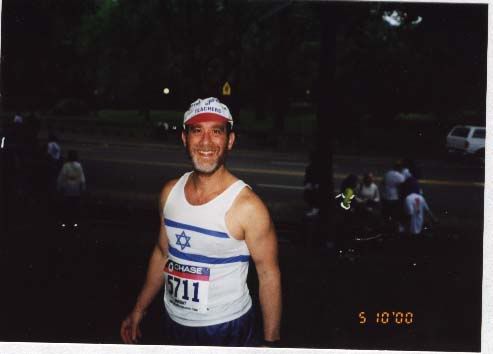
After finishing the race and claiming my bag, I left the festivities and made my way to the museum. I davened in a secluded alcove with benches, and then entered the museum itself. Ever since the museum opened, I would make a running pilgrimage in summer wearing a shirt with the Israeli flag on it. When I run the NYC Half (you have to be picked in a lottery to get in) I combine my visit with the race, visiting the museum in the sweaty glow of Jewish strength, with my race number still attached to my shirt, the irony not lost on me or, I hope, on other visitors who knew survivors with numbers tattooed on their arms. The museum consists of a permanent core and, since an additional wing was built, special temporary exhibits. One time I learned about the agricultural colony at Sosua in the Dominican Republic, the only country in the Western Hemisphere that welcomed Jewish refugees from Hitler. This time I had the privilege of viewing an exhibit on Jewish university professors who escaped from Germany and found positions in historically black colleges in the southern United States. Having known what it is to be a pariah and to experience persecution, those scholars formed a unique bond with their black students in the Jim Crow South. I then visited the core exhibit, making my usual stops at the Sifrei Torah that sit open in glass cases. The scrolls, as I learned from a museum educator who spoke at my shul several years ago, are pasul, damaged beyond repair and unfit for public reading, and therefore it is halakhically permissible to leave them open in that manner. Just the same, I am bothered by the idea of leaving an open Sefer Torah in a glass case to be gawked at. The Nazis intended to do just that and exhibit those scrolls in a "museum of an extinct race" in Prague. I therefore make a point of stopping at each one and reading a few verses with the traditional tune, dressed not for shul in a jacket and long pants, but davka as a Jewish athlete in the glory of summer, in short pants and a sleeveless top, my strong Jewish muscles out there for all the world to see. Extinct race, huh? That is my answer, and my own personal thumb in Hitler's eye. I am 57 years old and my running times are nowhere near what they used to be. I don't know for how long I will be able to run this race or make this pilgrimage, but I don't plan on going gently into the good night.

Labels: , , , , , ,

Monday, August 17, 2009

The Man in the Arena - The Strenuous Life

It is not the critic who counts; not the man who points out how the strong man stumbles, or where the doer of deeds could have done them better. The credit belongs to the man who is actually in the arena, whose face is marred by dust and sweat and blood; who strives valiantly; who errs, who comes short again and again, because there is no effort without error and shortcoming; but who does actually strive to do the deeds; who knows great enthusiasms, the great devotions; who spends himself in a worthy cause; who at the best knows in the end the triumph of high achievement, and who at the worst, if he fails, at least fails while daring greatly, so that his place shall never be with those cold and timid souls who neither know victory nor defeat.


Some might recognize this quote as coming from President Roosevelt. No, not FDR. The "other" President Roosevelt, Theodore "Teddy" Roosevelt, 26th President. The quote, which I use to decorate my classroom, is from a speech delivered at the Sorbonne in Paris a year after he left office in 1909. I am not ashamed to say that among my heroes are several Gentiles, and Teddy Roosevelt is one of them. I mentioned him at least once before in this blog. The President's life was an inspiration for my own. In particular, he had been a sickly boy like me, with a keen intellect and wide-ranging interests. His father told him in substance that he had the mind to be whatever he wanted to be, but to make the most of it he would have to make the body. He set up a gym in the back of his house (this was the late 19th century, before health clubs became ubiquitous) and the young Teddy Roosevelt made the body. He transformed himself into a robust young man, and at the age of 39, during the Spanish American War, resigned as Secretary of the Navy to personally lead the Rough Riders in the charge up San Juan Hill.


The Rough Riders


I did not learn until recently that Teddy Roosevelt lived most of his adult life not far from here, on a large estate that he named Sagamore Hill near Oyster Bay in Nassau County, that his estate is now administered by the National Park Service as a National Historic Site and that he is buried not far from his estate. As a child I visited FDR's estate in Hyde Park with my parents, and last week I visited Sagamore Hill by myself. Thanks to Google Maps I was able to ascertain that the trip was possible without a car, and to plan out my route in advance. I took the Long Island Railroad to Oyster Bay and ran about a mile and a half to the gravesite. I could have taken a taxi from the train station, but that would have been cheating, like riding the cable car to the top of Masada. To truly experience the meaning of Sagamore Hill or Masada, you have to challenge yourself physically with a demanding run, bike ride, hike or climb.


Citizens of Oyster Bay are justly proud of Teddy Roosevelt having called their town home. A bust of the President stands beside a war memorial at the town hall.


On the way to the cemetery, you pass Oyster Bay High School, beautifully landscaped like a college campus. Oyster Bay is a wealthy community, and students there cannot help but see that the community takes their education seriously. It is all a matter of values.


The grave is located at the top of a hill, and you reach it by climbing 26 steps, Roosevelt having been the 26th President. The grave itself is enclosed by a fence to prevent the stone from being damaged by repeated touching; you might have noticed that the massive Herodian stones of the kotel are worn smooth up to the height of a tall man by centuries of rubbing and kissing.


I found a couple of people visiting; it is gratifying to know that 90 years after his death people still revere his memory enough to visit the simple grave. After they left I recited a couple of Psalms and wrote a small kvittel (note), which I inserted through the fence into the grass on the other side. Then I left the cemetery and ran another mile and a half, mostly uphill, to Sagamore Hill itself.


The day was hot and muggy. I had prepared for the run by drinking a 20-ounce bottle of Powerade, which I purchased at the beachfront park near the train station. The concession stand was staffed by high school or college aged kids. Could it be that they have responsible parents, who teach them the difference between "I need" and "I want?" What they need, their parents provide. What they merely want, they have to work for. When I reached the entrance to the estate, I was drenched with sweat. I didn't mind. The hard effort was part of my communion with Teddy Roosevelt, who extolled The Strenuous Life and did not seek ease and comfort.


At the visitors' center I was amused by a sign warning that Teddy Roosevelt's house was not air conditioned and the indoor temperature was in the 80s. The house had fans whirring and providing all the cooling I needed; I would have felt cold if it had been air conditioned. Alas, the furnishings dating from the President's lifetime disagree. They are deteriorating due to summer heat and humidity, and next year the house will be air conditioned, with a new technology that will not detract from the architecture. Teddy Roosevelt was an avid hunter and conservationist; the two often go together. The house is decorated throughout with rugs made out of skins of animals he hunted, with the heads still attached in the style of the time (warning to the squeamish). Indoor plumbing was a rarity when the house was built, and you can see the pull-chain toilet.

I visited the museum, housed in another building that was air conditioned. Here are some photos of the exhibits:


The Man in the Arena


Political considerations delayed Teddy
Roosevelt's Medal of Honor for nearly a
century after the action for which he
earned it.


Teddy Roosevelt assumed the Presidency in 1901, following the assassination of President William McKinley. Sixty-two years later, Lyndon B. Johnson would become President in the same way. May we be spared such tragedies in the future.


"We love all the seasons. . . ."
I am decidedly partial to summer.


A sign posted on the grounds by the National Park Service warns visitors of the dangers of heat exhaustion. I made sure to drink plenty of water before the three-mile run back to the railroad station. Then I filled up again with a bottle of Powerade. If you're in shape, acclimatized and pace yourself appropriately, you can stay out of danger. San Juan Hill was not air conditioned.


Sagamore Hill is an inexpensive and enjoyable destination. I got a lot out of the trip, and I recommend it to any athlete who admires Teddy Roosevelt as I do, and who is not afraid to challenge himself and to embrace the strenuous life.

Labels: , , , , , ,

Friday, July 10, 2009

Stonewall means fight!

For New Yorkers and most Americans of a certain age who aren't living in a cave, the Stonewall Inn in Greenwich Village represents the struggle of gay Americans for basic human rights other Americans have long taken for granted. It all began 40 years ago in June. Gay Americans, even in a sophisticated and cosmopolitan place like New York City, lived closeted lives of constant fear. They got together in gay bars that were connected with organized crime and were constantly raided by police, who would rough up and arrest patrons. The Stonewall was one such bar, and was routinely raided one evening in late June 1969, only this time it would not be routine. The patrons decided they had had enough. They resisted, sparking three nights of confrontations between young gay men and the police. I'm deliberately not calling them riots, because they were very mild compared to the racial rioting that was tearing American cities apart in the late '60s. One thing led to another, and here we are today.


I recently ran by the Stonewall Inn. For me it represents a piece of my city's history and a piece of Americana. You don't have to be gay to appreciate the universal struggle for human rights. It resonates with me as an American and more so as a Jew because of our history of being denied the most basic human rights in unhappy lands of persecution. When one man's rights are taken away, all men are diminished. I'm not talking about changing the definition of marriage now - though who would have dreamed 40 years ago that we as a country would be debating that today? I'm talking about the right to live anywhere one can afford, to hold a job whose duties one can perform, to be served in a place of public accommodation, and the like. I'm talking about the right not to have to live a lie - whether that means going to the company picnic with a kippa on one's head or with one's gay partner (or both - click here!). Above all, I am talking about the right to walk the streets in safety, without fear of being set upon and beaten because some thugs perceive you, rightly or wrongly, as gay, black, Jewish or whatever. Both gays and Orthodox Jews suffered from a stereotype as sissies (or, to quote R. Meir Kahane hy"d, patsies) who can be physically attacked and beaten with impunity. Many of my friends were beaten on the street growing up identifiably Jewish in the '60s, though praise God that changed in the aftermath of the Six Day War. And it did not change because of the goodness of thugs' hearts. It changed because the Israeli army and air force showed the world another image of the Jew, that of a strong Jew able and willing to stand up for himself. And that is what Stonewall did for gays. One Matthew Shepard is one too many. And the solution for gays is the same as it was for us Jews - an ability and willingness to teach hoodlums a lesson with Jewish or gay fists.


Labels: , , , , ,