Tuesday, July 21, 2015

Much Ado About Nothing


   The title of this Shakespeare play actually sounds better in Hebrew than in English: Rov Mehuma Al Lo Me’uma (רוב מהומה על לא מאומה), and it summarizes the latest rabbinical “scandal” eagerly reported in a New York Times “expose” and just as eagerly picked up by The Jewish Week.  It was reported that Jonathan Rosenblatt, the rabbi of long standing at Riverdale Jewish Center, a prominent Orthodox synagogue in the Bronx, had played squash and racquetball with young male congregants, then showered with them naked (that’s how men usually shower) and sat with them in a sauna or steam room, naked or wrapped in a robe (as men usually are when they use saunas and steam rooms).  This had gone on for decades and reporters at both publications had known about it for decades, but did not report it until now because only now was one person man enough to speak for attribution.  Plenty of others were ready to bad-mouth the rabbi, but only behind a veil of anonymity.
 
   Among the words used to describe Rabbi Rosenblatt’s conduct are “disturbing,” “inappropriate,” “unusual,” and words of that ilk.  Never “illegal” or “criminal.”  By all accounts there was no sexual touching or other sexual misconduct, as occurred in other well-publicized sex scandals involving rabbis.  The New York Times article itself states that “parsing [the rabbi’s conduct] is an exercise in ambiguity.”  If so, and given Rabbi Rosenblatt’s stature, are we not required to be דן לכף זכות, to give the rabbi the benefit of the doubt?
 
  Up until the middle of the 19th century it was unusual for any observant Jew to play organized sports.  Then Jewish consciousness began to be raised by the Zionist movement and men such as Max Nordau.  Young Jewish men, first secular and then observant, began seeing their bodies and minds as an integrated whole, each feeding off the other.  Orthodox rabbis, however, remained the black-suited, black-hatted purveyors of scholarship and dared not step out of that realm, except maybe to escort congregants to Soviet Jewry demonstrations or Salute to Israel (now Celebrate Israel) parades.  Rabbi Rosenblatt, it seems, was the first to think and act outside of that box, and more power to him.  Several years ago the chief rabbi of Warsaw was attacked and beaten by anti-Semitic Polish hoodlums.  Just imagine if he had been able to give those goons a proper rabbinical butt whooping.  It would have been a tremendous kiddush Hashem, a veritable earthquake, with aftershocks rippling with his muscles through the length and breadth of Poland.  No more would the few Jews left in Poland be seen as easy marks.
 
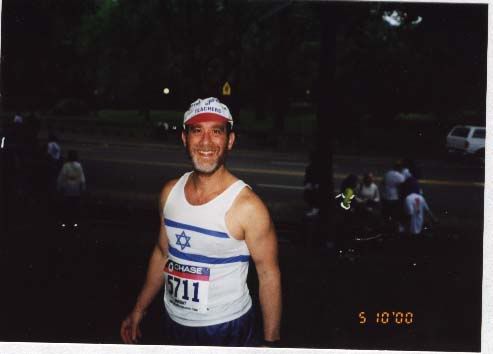
   One of the anonymous complaints concerned the rabbi lingering in a post-workout shower with the boys and young men with whom he was bonding; there was no rush.  Why should there have been a rush?  Were they expecting a trainload of Jews arriving and having to use the shower?  A shower after a hard fulfilling workout may be routine for others who take their physicality for granted, but for us it is a mystical experience of supernal joy.  That’s water coming out of those shower heads, not gas.  We draw water with joy from the wells of salvation (see Is. 12:3).  Take as long as you want.  Sing, whoop and holler if you feel like it.  Savor the experience as you would good wine.  I remember running races in the summer heat and makeshift showers would be set up along the course.  I’d pump my fist in the air, run through and shout “l’chaim” – to life.  Who needs drugs when you can get high on pure Jewish joy?  It is said that at the entrance to the gas chamber at Auschwitz hung a sign reading  זה השער לה' צדיקים יבאו בו  - This is the gate of the Lord; the righteous shall enter it (Ps. 118:20).  Perhaps the showers of gyms at yeshivot and Jewish community centers should have signs reading יבואו בו זה השער לגאולה חזקיםThis is the gate of redemption; the strong shall enter it.  I remember taking showers in school after gym or swimming, naked with my classmates in full view of one another, and thinking nothing of it.  I don’t remember if the teachers showered with us, but if they had it would have been no big deal.
 
   The person who apparently was leading the charge against Rabbi Rosenblatt is female and, not surprisingly, knows nothing about male bonding and male fellowship.   She does not understand why the rabbi “didn’t get”  his alleged judgment error.  Actually, it is she that “doesn’t get it.”  We men need to be with one another where females are absent, to be “out with the boys.”   Time was when construction workers, longshoremen (those brawny fellows who unloaded ships before modern containerization) and such working in Lower Manhattan would, after a hard day’s work, repair to McSorley’s Ale House and enjoy some salty man talk in one another’s company over a pint or two.  No more.  Since 1970 McSorley’s must, per court order, be open to women.  In Russia, Eastern Europe and Turkey the steam bath (and in Scandinavia the sauna) filled the role of McSorley’s.  Jewish men coming here from that part of the world brought the “shvitz” culture with them, and passed it on to their progeny.  So here we have an Orthodox rabbi who worked out with boys and young men, then showered and spent time in the steam room or sauna with them, discussing matters of faith and philosophy in a relaxed atmosphere where they could let their guard down.  Why would any man or boy get uptight over it?  Mothers did, and that is understandable.  Among other functions, these male-only get-togethers removed boys, if only temporarily, from the influence of their overbearing Jewish mothers, taking them out of the world of women and into the world of men.  That can be traumatic for women who can’t let go of their little darlings, but for their sons it is liberating and healthy.
 
   To be sure, there were minor errors in judgment.  Most of them stem from not adhering to a fundamental part of the masculine mystique in America, dating from the Old West, that exhorts us to never say behind a man’s back what you would not say to his face.  Interestingly, this echoes a saying of one of the European ba’alei mussar of the late 19th and early 20th centuries: Don’t talk about people; talk to them.  In Israel men are expected to “talk dugri,” i.e. direct and to the point.  Some of the young men were uncomfortable with the rabbi’s style, or so they told reporters years or decades later.  With the passage of time, memory can play tricks, but it is perfectly reasonable that some people would be uncomfortable.  In modern societies (but it would seem not in the primitive ones that renowned anthropologist  Margaret Mead visited) puberty and adolescence is characterized by a great deal of Sturm und Drang.  Young people are prone to read into situations what is not necessarily there.  What one person experiences as a glance, or even thinks nothing of, can be experienced by someone else as gawking.  When I was in high school, a male biology teacher once remarked to a classmate, “those biceps [mine] are unreal.”  Having been lifting weights for several years,  I took it as a compliment, large biceps still being unusual in American yeshiva boys in the 1960s.  Given the anxieties teenage boys experience about their sexuality, anxieties not addressed by the limudei kodesh teachers (only one specific act is Biblically prohibited), some other boy might have experienced the same remark as “creepy.”  The boys and young men who were uncomfortable with nudity in the shower and/or steam room should have simply told the rabbi.  Alternatively, they could have asked him if this was appropriate behavior for a rabbi, perhaps citing sources if they could.  It could have opened the door to some interesting and healthy conversation.  One student recalled getting sick in yeshiva and being driven home by the rabbi, with pleasant conversation in the car.  When they arrived at the student’s home (the parents were not present), the rabbi suggested the boy might be more comfortable if he changed into a bathrobe.  This was not far-fetched; yeshiva clothes can be distinctly uncomfortable, especially when one is not feeling well to begin with.  The boy did not want to change, and told the rabbi.  According to the boy’s recollection, the rabbi stayed in the student’s house (is there any yihud issue between two males?) and persisted in trying to get the boy to change.  With 20/20 hindsight I understand and sympathize with the boy feeling put in an awkward spot.  Some of the people involved were so put off that they chose another synagogue to attend.  This too is nothing out of the ordinary; in any community where there is a choice of synagogues congregants come and congregants go.  Leaving is the best solution when a personality clash between congregant and rabbi is so deep that remaining together becomes untenable.  Others, however, benefited a good deal from those encounters and are appalled that the rabbi, to their way of thinking, became the object of a malicious smear campaign (lashon ha-ra) years later.  Students in Yeshiva University kept coming, of their own volition, to do rabbinic internships with him even when the university stopped sending students his way due to complaints, some of which were justified.  The power relationships between rabbi and intern could create the appearance that the scantily clad shvitz sessions were necessary for the intern’s career advancement.  Similar situations could occur between professors and undergraduate or graduate students at a secular university; today professors assiduously avoid any interaction that can give any such appearance.
 
   The entire matter seems to have been resolved to most everybody’s satisfaction.  The rabbi will be staying out the few years remaining on his contract.  This resolution was reached after a frank exchange between rabbi and congregants, accompanied according to press reports by self-flagellation on the part of the rabbi that I think was unnecessary given that few if any people came to any serious harm.  I fail to see any hillul Hashem here, nor any reason for the rabbi to feel broken. We all recall positive and negative interactions with authority figures in our lives, interactions as inevitable as they are universal.  If there is anybody among us who never committed errors in judgment, he or she may cast a stone.  The rest of us mortals live in glass houses.


Labels: , , , , , , , , , , , ,

Sunday, February 22, 2015

 
Reflections
 
  
   I notice that I have not added to my blog since Purim.  Actually, a Jewish publishing house based in Germany (of all places) noticed and asked me to send in samples for possible publication.  I would welcome my work being introduced to a wider audience, and a foot in the door of commercial writing would also be welcome. 
   Probably the most significant event affecting the Jewish world since Purim 5774 was the war in Gaza.  Israel finally had enough with the daily rocket fire from Gaza, which they evacuated in 2005 in return for empty promises quickly repudiated by Hamas once it violently seized power.  In addition, Hamas was busy digging tunnels under the border, with the intention of kidnaping Israeli civilians and committing other acts of terror.  So the Israelis invaded Gaza, destroyed the tunnels and some of Hamas’s military assets and returned.  Israel seems to do this every few years, as Hamas quickly rearms and the world does nothing. This strategy is sometimes referred to as “lawn mower operations” since despite all the rhetoric on both sides everybody knows that the “grass” will regrow and Israel will have to enter Gaza later to re-mow it.  Every time Israel conducts one of these operations it is excoriated by the United Nations, the European Union and the liberal mainstream media in the United States for the heavy collateral damage, particularly the deaths of many children.  This damage is made inevitable by Hamas’s cynical tactic of placing its military assets in hospitals and schools full of children, as well as in private homes whose occupants are not allowed to leave, in order to score propaganda points with the above-named entities.  Israel has always done, and still does more than any other army on earth to prevent civilian casualties.  It even drops flyers and knocks on roofs to warn civilians of the precise buildings to be attacked, so that civilians may leave.  Those civilians must then choose between leaving and being killed by Hamas if they are discovered, and staying and being killed or injured in the military operation.  Imagine the United States and its allies doing that in World War II.  I say that next time Hamas’s shenanigans force Israel to invade, it should leave the lawn mowers behind, enter with overwhelming force, clean out the vipers’ nests once and for all and STAY.  Show the Arabs as much mercy as the allies of World War 2 showed the Germans.  Destroy any buildings used to attack Israelis, no matter who else is inside.  If so much as a cap gun goes off from a mosque, level said mosque.  Let the world rant and rave all it wants to, remind the media that they went in because the enemy deliberately targets Israeli civilians, including children, and that no other country would tolerate such conditions.  The world will condemn us anyway, so who cares?  Rebuild the settlements that were evacuated; no doubt most of the evacuees will be only too happy to return to their homes and make the land flourish as it did before the expulsions.  The war sparked outbursts of anti-Semitism all over western Europe, especially in France.  French Jews are still afraid to walk the streets wearing kippot (skullcaps) and police must be deployed around synagogues so that Jews can enter and leave peacefully.  Many of them decided that they have no future in France and are leaving for Israel.  They can be helped to build homes in Gaza (city and strip) and strengthen the Jewish presence.  Same goes for the haredim with their high birthrates and low levels of education; let them work the soil and justify their existence. 
   Close on the heels of the Gaza war came the Yamim Noraim (high holidays) and my own personal misfortune.  On the Sunday morning of Selihot (penitential prayers recited during the season) I missed a step at home, fell sideways and twisted my knee.  Somehow I made it to the nearest emergency room, where they took x-rays, ascertained that I did not break a bone, gave me a brace and a cane and told me to see an orthopedist.  The orthopedist ordered an MRI and diagnosed a torn anterior cruciate ligament (ACL) and meniscus (cartilage).  I already had two arthroscopies on the same knee to repair damaged cartilage.  So another arthroscopy was done to remove the damaged cartilage and replace the ligament with tissue from a cadaver.  The ACL injury is the same one suffered by professional football and basketball players; it inevitably sidelines them for the season and I was promised a similarly long recovery.  I am still assiduously doing physical therapy to rehabilitate the injury. 
   On the evening before my accident I attended the Selihot at Kingsway Jewish Center.  For several reasons I found it difficult to relate to.  Many of the piyutim (liturgical poems) are very difficult to understand because they are written in an abstruse style of medieval Hebrew (unlike the amidot, which anybody who understands Hebrew can comprehend) and the authors assume a broad knowledge of Talmud and Midrashim that we moderns do not possess.  These poems are valuable, but are better studied than recited in prayer.  Sefaradim begin Selihot on Rosh Hodesh Elul; perhaps we should convene starting then to study the more esoteric texts.  Many of the poems that we do understand portray the Jewish people as weak, helpless and hounded, which was true when they were written but not today, when Barukh Hashem we are witnessing and participating in the unfolding geula (redemption).  One in particular describes two nations, Sheba and Dedan, which refer to Arab provinces where Jews were living as dhimmis (second-class citizens), as possessing mighty armies while we are helplessly subjugated to them.  Huh?  In my mind’s eye I see the piles of shoes and burned-out equipment that the Arab armies left for us in June 1967.  Sometimes changing the tense of a verb or two will make the poem consonant with reality on the ground, but sometimes it will not.  In that case I cannot get the words out of my mouth; doing so would show a crass ingratitude to God, Who is turning our fortunes around before our very eyes, just as the Prophets told us He would.  Finally, the hazzan (cantor) pronounces the holam (vav with a dot above it) as if it was followed by the letter yod, i.e. an “oy” sound.  He also, as is customary on the Yamim Noraim, sprinkles “oy vey,” liberally throughout the text.  All of this has an unmanly, and therefore unwelcome, ring.  We are not an “oy vey” people anymore; we have earned the world’s respect and admiration for our ability to kick butt.    Neither the pronunciation nor the textual emendation is wrong per se; I cannot fault a man for following his family minhag (custom), but every “oy” and “oy vey” grates on my macho ears, and the older I get the more it grates.  I would like to hear the Selihot and the services on Rosh Hashanah and Yom Kippur from an Israeli hazzan who pronounces a holam the Israeli way and does not add “oy veys” that are not found in the printed text.  I would also like the piyutim that describe our past subjugation as if it were present, and that cannot be fixed, simply passed over.  Perhaps people more creative than I am can compose piyutim expressing our gratitude to God for the unfolding geula; these can be substituted for the traditional piyutim that, praise God, no longer have a basis in reality. 
   On a happier note, I became a grandfather for the first time when my daughter gave birth to a daughter on the first day of Shavu’ot 5774.  My granddaughter was named Lianna Batya or Lilliana Beth, but we call her Lily.  We’re all delighted with our cute little girl, but I want her to grow into a big strong girl, in body, mind and spirit, able to advance the geula.  My son got married in Israel on 27 Tevet 5775 to a Sabra girl from Yemenite stock.  They live in Petah Tikva.  I and my wife traveled to Israel for the wedding and sheva brakhot.  May it be God’s will that I should soon return to Israel for a brit milah and pidyon ha-ben, and that we all merit to see the completion of the geula and, before I get too old and weak to put one brick on top of another,  the rebuilding of the Beit Hamikdash.


Labels: , , , , ,

Tuesday, May 28, 2013

In Flanders Fields


In Flanders Fields
by John McCrae, May 1915


In Flanders fields the poppies blow
Between the crosses, row on row,
That mark our place; and in the sky
The larks, still bravely singing, fly
Scarce heard amid the guns below.


We are the Dead. Short days ago
We lived, felt dawn, saw sunset glow,
Loved and were loved, and now we lie
In Flanders fields.


Take up our quarrel with the foe:
To you from failing hands we throw
The torch; be yours to hold it high.
If ye break faith with us who die
We shall not sleep, though poppies grow
In Flanders fields.


Some (I would hope many) of us have seen this poem, written in 1915 by a Canadian soldier in the First World War.  It appears in many newspapers on Memorial Day, along with the ads for all the store sales.  Today people wish one another a Happy Memorial Day.  Happy?  We were a richer country when Memorial Day was Decoration Day, a solemn day of reflection on the high cost of our freedom as Americans, and not an excuse for a shopping spree and the “unofficial start of summer.”  When this was written the United States had not yet entered the war.  We were Johnny-Come-Latelies in both world wars, which would almost certainly have ended sooner and been less costly in blood and treasure if we had entered together with the British and Canadians.  My parents were not yet born, and their parents were still in Eastern Europe.  “Between the crosses, row on row”?  It wasn’t only crosses.  Jewish blood was spilled on every American battlefield since the Revolution, but until very recently America was overwhelmingly Christian.  There were relatively few Jews in America, and fewer still in Canada.  In those days before refrigeration, fallen soldiers were buried near where they fell, but Jewish ones would almost certainly have been buried in Jewish cemeteries.  Hence the crosses, row on row.
 
Truth be told, both my grandfathers fought in the Austro-Hungarian army, i.e. on the wrong side.  The same was true of the grandfathers of many if not most of my generation of American Jews.  My mother’s father was brought here as a prisoner of war, and my father’s parents came here fleeing the Nazis in the 1930s.  Our grandfathers’ having borne arms against America was not something we talked about much, even in the safety of yeshiva.  We were not proud of it.  For those who attended public school, talking about it would have certainly landed Jewish kids in a few fistfights.  But time, they say, heals all wounds and from nearly a century’s distance we can see a reflection of both the tragedy of galut (exile) and the greatness of America.  Up to and including the First World War, Jewish soldiers fought on both sides.  There is an account from either the First World War or the Franco-Prussian War of a Jewish soldier stabbing an enemy soldier with a bayonet (a lot of the killing was still up close and personal) and hearing him cry out “Shema Yisrael.”  The Jew who did the stabbing is said to have spent the rest of his life in a mental institution.  But here in America something happened that could not possibly happen anywhere else.  When my maternal grandfather refused repatriation to Hungary after the war and took the oath of citizenship, and when my paternal grandfather took his oath, they were accepted as Americans in every sense.  They started businesses, rebuilt their lives, married and, on my mother’s side, had American born children who looked and acted American and spoke English without a trace of an accent.  For this country was founded not on blood and iron but on an idea, rooted in our Tanakh (what Christians call the Old Testament), that all men are equal, before God and before the law.  People can come here and leave the Old World’s broils behind.  In my first year of teaching I had a Greek student whose best friend was a Turk.  A Turk!  Greeks and Turks were mortal enemies at each other’s throats for centuries.  My student laughed when she told me this.  Only in America!  And one of my best students ever was an Arab from Ramallah.  This great American idea was radical when America was founded; every dollar bill carries the Great Seal on which is inscribed “Novus Ordo Seclorum,” a new order of the world.  Every coin carries the inscription “E Pluribus Unum,” from many, one.  But our new order is still not universally adored. In every generation people rise against us to eradicate us, not only to kill us physically but to exterminate the idea on which we stake the very existence of this country.  Early in the past century it was the Nazis, then the Communists.  Now the enemy is Islamism.  Islamofascists don’t hate tall buildings, or they would have destroyed the world’s tallest building in Kuala Lumpur, Malaysia.  They don’t hate marathons; there are plenty of those in their own benighted lands.  Islamofascists hate America.  For as long as America remains a beacon of hope and freedom for the world, they will never be able to march the world back to the seventh century.
 
And so we must once again take up our forebears’ quarrel with the foe, grab from their hands the torch of freedom and hold it high.  We dare not break faith with the heroes who made the ultimate sacrifice, and who now sleep in Flanders Fields.


Labels: , , , ,

Sunday, November 25, 2012

In Memoriam: John F. Kennedy


   Last Thursday – Thanksgiving – was the 49th anniversary of the assassination of our thirty-fifth President, John Fitzgerald Kennedy.  We were invited by our mehutanim (in-laws) for Thanksgiving dinner.  Somehow it just didn’t feel right to sit down to a feast on November 22; I always feel like an avel (mourner) on that day.  Why can’t Thanksgiving be postponed one week to November 29, the fifth Thursday in November, when the fourth Thursday is November 22?  I wasn’t able to run the Thanksgiving Turkey Trot in Prospect Park; when Thanksgiving coincides with this terrible anniversary I run it with a special custom-made shirt, then repair to the monument at Grand Army Plaza to recite tehilim (psalms) and leave my race number, suitably inscribed.  As it turned out, if I’d known that “be here at 2:00” meant Jewish time, I would have been able to run the race.  It took this alteration of my routine to show me just how much doing that run meant to me; the depression that comes over me every year on November 22 took much longer than usual to lift this year, despite thoroughly enjoying the company of my in-laws.  


   During JFK’s campaign to secure the Democratic nomination in 1960, much was made of the fact that he was a Roman Catholic.  Supposedly, if he were to be elected, American policy would be made in the Vatican and not the White House, c.f. the oft-repeated concern of Irish Protestants that “home rule means Rome rule.”  This is what John F. Kennedy had to say about such concerns when he accepted his party’s nomination:


I am fully aware of the fact that the Democratic Party, by nominating someone of my faith, has taken on what many regard as a new and hazardous risk new, at least since 1928. The Democratic Party has once again placed its confidence in the American people, and in their ability to render a free and fair judgment and in my ability to render a free and fair judgment.

To uphold the Constitution and my oath of office, to reject any kind of religious pressure or obligation that might directly or indirectly interfere with my conduct of the Presidency in the national interest. My record of fourteen years in supporting public education, supporting complete separation of Church and State and resisting pressure from sources of any kind should be clear by now to everyone.
 

I hope that no American, considering the really critical issues facing this country, will waste his franchise and throw away his vote by voting either for me or against me because of my religious affiliation. It is not relevant. I am telling you what you are entitled to know: As I come before you seeking your support for the most powerful office in the free world, I am saying to you that my decisions on every public policy will be my own, as an American, as a Democrat, and as a free man.


   The President-to-be must have had a terrific speechwriter.  Nothing could have been clearer.  I first heard it shortly after the assassination, and it still rings in my ears, as does his Inaugural Address.  Contrast this ringing affirmation of American ideals and his own political independence with what I heard sometime in the 1980s from that professional hater and perennial candidate for local public office, Rabbi Yehuda Levin.  During one of his campaigns, asking for the votes of the Orthodox community, he stated that he was a shaliah (messenger) of gedolim (prominent rabbis) and, if elected, would do their bidding.  He said that he was looking for someone to say alai kilelatkha b’ni  (see Gen. 27:13), to take the blame if he, Yehuda Levin, messed up.    The battle lines could hardly be more starkly drawn: a man with wide shoulders willing to take responsibility for his acts in office, and some of them were less than creditable (the Bay of Pigs invasion comes to mind), versus an errand boy for old greybeards.  And ever since, campaigns by Orthodox candidates for public office consist mainly of contests to garner the most haredi Rabbinical endorsements and pabulum about “sharing our values.”


   Some sort of yeridat ha-dorot (generational decline) seems to be at play here.  In those days there were giants on the earth (see Gen. 6:4).  Now we have nothing but pygmies.  Heaven help us all.


Labels: , , , ,

Sunday, September 30, 2012

Birds of a feather flock together

It seems the Iranians are also steamed up about the Internet, and their rantings sound eerily like those of the haredim.  Click on this link:
http://news.yahoo.com/iran-swipe-brings-angry-reply-184348436.html


                                            Iran swipe at Web brings angry reply

     Iran greets outcry over Web squeeze with fresh promises for Tehran-centric cyberworld


<p>               FILE- In this Monday, Feb. 13, 2012 file photo, Iranian women use computers at an Internet cafe in central Tehran. Iran’s cyber monitors often tout their efforts to fight the West’s 'soft war' of influence through the web, but trying to ban Google’s popular Gmail may have gone too far with complaints coming even from email-starved parliament members. (AP Photo/Vahid Salemi, File)
Associated Press -
FILE- In this Monday, Feb. 13, 2012 file photo, Iranian women use computers at an Internet cafe in central Tehran. Iran’s cyber monitors often tout their efforts to fight the West’s 'soft war' of influence through the web, but trying to ban Google’s popular Gmail may have gone too far with complaints coming even from email-starved parliament members. (AP Photo/Vahid Salemi, File)

TEHRAN (AP) -- Iran's cyber monitors often tout their fight against the West's "soft war" of influence through the Web, but trying to block Google's popular Gmail appeared to be a swipe too far.
Complaints piled up — even from email-starved parliament members — and forced authorities Sunday to double down on their promises to create a parallel Web universe with Tehran as its center.
The strong backlash and the unspecific pledges for an Iran-centric Internet alternative to the Silicon Valley powers and others highlight the two sides of the Islamic Republic's ongoing battles with the Web. It's spurred another technological mobilization that fits neatly into Iran's self-crafted image as the Muslim world's showcase for science, including sending satellites into orbit, claiming advances in cloning and stem cell research and facing down the West over its nuclear program.
But there also are the hard realities of trying to reinvent the Web. Iran's highly educated and widely tech-savvy population is unlikely to warm quickly to potential clunky homegrown browsers or email services. And then there's the potential political and economic fallout of trying to close the tap on familiar sites such as Gmail.
"Some problems have emerged through the blocking of Gmail," Hussein Garrousi, a member of a parliamentary committee on industry, was quoted Sunday by the independent Aftab-e Yazd daily. What he apparently meant was that many lawmakers were angry and missing their emails.
He said that parliament would summon the minister of telecommunications for questioning if the ministry did not lift the Gmail ban, which was imposed last week in respond to clips on Google-owned YouTube of a film mocking the Prophet Muhammad that set off deadly protests across the Islamic world.
Even many newspapers close to the government complained over the email disruptions. On Saturday, the Asr-e Ertebat weekly reported that Iranians had paid a total of $4.5 million to purchase proxy services to reach blocked sites, including Facebook and YouTube, over the past month.
Iranian authorities — perhaps recognizing the risks at hand — decided against taking a symbolic twin shot at Google and cut access to the Web browser in a country with 32 million Internet users among a population of 75 million, according to official statistics.
That would rank online Iran among the world's top 20 in terms of sheer numbers of users, and equivalent to some European countries in per capita Web use at more than 40 percent, according to the private monitoring group Internet World Stats. The World Bank, however, puts Iran's Internet link rate at just 21 percent last year. The U.S. is among the world's highest at more than 75 percent. Iran's deputy telecoms minister, Ali Hakim Javadi, told reporters that Iranian authorities were considering lifting the Gmail ban. But he also used the opportunity to again promise development of Iran's domestic alternatives: the Fakhr ("Pride") search engine and the Fajr ("Dawn") email, Aftab-e Yazd reported. When reporters noted the quality of Gmail services, Javadi quipped: "If there is Mercedes Benz on the street, that doesn't mean everyone drives a Mercedes." Iran's clerical establishment has long signaled its intent to get citizens off of the international Internet — which they say promotes Western values — and onto a "national" and "clean" domestic network. Earlier this year, Iran's police chief, Esmail Ahmadi Moghadam, called Google an "instrument of espionage" rather than a search engine. But it is unclear whether Iran has the technical capacity to follow through on its ambitious plans, or is willing to risk the economic damage and the social shock waves. The Internet has steadily become part of Iran's fabric since the first Farsi-language sites developed a decade ago by Canadian-Iranian blogger Hossein Derakshan, who is considered one of the founders of Iran's social media community. Derakshan, however, was detained in 2008 and sentenced to nearly 20 years in prison two years later as the battles heated up between liberals seeking open access to the Web and authorities trying to erect their own version of China's "Great Firewall," the name given to Beijing's extensive filtering and censorship of the Internet.
Sites such as Twitter and Facebook were pillars of the street revolts after the disputed 2009 re-election of President Mahmoud Ahmadinejad. The powerful Revolutionary Guard responded by recruiting and training its own cyber force to patrol the Web and, later, try to defend against virus attacks on nuclear and other sites that Iran has blamed on the West and its allies. Some Web security experts also have raised the possibility of Iranian hackers being behind some recent high-profile computer attacks, such as disruptions at Saudi Arabia's state oil giant Saudi Aramco and Qatari natural gas producer RasGas earlier this month. Iran has denied any links. In a video message for Iranian new year in March, President Barack Obama denounced what he called the "electronic curtain" that keeps ordinary Iranians from reaching out to Americans and the West.
A few weeks later, Supreme Leader Ayatollah Ali Khamenei ordered the creation of an Internet oversight agency that included top military, security and political figures in the country's boldest attempt yet to control the Internet. The panel is headed by Ahmadinejad and includes powerful figures in the security establishment such as the intelligence chief and the commander of the Revolutionary Guard.
It's not Iran's first attempt to hold off what hardliners call a Western "cultural invasion." The so-called Barbie wars have gone on for more than a decade with periodic raids to confiscate the iconic American dolls from toy stores. Iran also introduced its own dolls — twins Dara and Sara — designed to promote traditional values with modest clothing and pro-family values, but it hasn't significantly dented the demand for Barbie dolls. ___
Murphy reported from Dubai, United Arab Emirates.


It will be remembered that certain haredi elements, notably Neturei Karta, make buddy-buddy with the Amalekim of Teheran who seek to destroy us.  Perhaps the haredim will invite a contingent of Iranians to their next confabulation at Citi Field.  Or maybe it won't be necessary.  I have a message for them:  Take your bans, your broadsides and your filters and hop a plane to Iran.  American planes don't go there?  I'm sure you can get connections by way of Cairo or Damascus.  Or maybe take a plane to Uman, Lizhensk or any of the stinkholes of Eastern Europe that your parents and grandparents came crawling out of and recreate your pre-Holocaust world of insularity, ignorance and weakness, physical and mental.  To the Rabbinical Council of America: Quit looking over your right shoulder and grow yourselves a pair.  Defend intellectual freedom whenever and by whomever it is under attack.

   Iran, Communist China and the Orthodox crazies can keep their narrow world view.  We want no part of it.  We march confidently forward, backs straight and shoulders square, to meet the approaching ge'ula.  May it go to completion swiftly in our time.


Labels: , , , , , ,

Wednesday, May 16, 2012

Palestine is Desolate


   In this month of mourning for the defeat and murderous persecutions at the hands of the Romans in 135C.E., and of rejoicing for the miracles experienced in our own time, it is instructive to go back 145 years, to Mark Twain’s Innocents Abroad, first published in 1867.  Mark Twain’s book is based on  a tour of Europe and the Middle East that he took with some friends.  These quotes are taken from the Modern Library Edition, New York, 2003: 


Galilee:  (p.358) – There is not a solitary village throughout its whole extent – not for thirty miles in either direction. There are two or three small clusters of Bedouin tents, but not a single permanent habitation.  One may ride ten miles, hereabouts, and not see ten human beings.


Tiberias (p.374) – They say that the long-nosed, lanky, dyspeptic-looking body-snatchers, with the indescribable hats on, and a long curl dangling down in front of each ear, are the old, familiar self-righteous Pharisees we read of in the Scriptures.  Verily, they look it.  Judging merely by their general style, and without other evidence, one might easily suspect that self-righteousness was their specialty. 


Entering Jerusalem (p.418) – Rags, wretchedness, poverty and dirt, those signs and symbols that indicate the presence of Moslem rule more surely than the crescent-flag itself, abound.  Lepers, cripples, the blind, and the idiotic, assail you on every hand. . . .Jerusalem is mournful, and dreary, and lifeless.  I would not desire to live there.


Summarizing (p.456) – Of all the lands there are for dismal scenery, I think Palestine must be the prince.  The hills are barren. . . .The valleys are unsightly deserts fringed with a feeble vegetation that has an expression about it of being sorrowful and despondent.  . . .It is a hopeless, dreary, heart-broken land.. . . .Palestine sits in sackcloth and ashes.  Over it broods the spell of a curse that has withered its fields and fettered its energies.. . .Renowned Jerusalem itself, the stateliest name in history, has lost all its ancient grandeur, and is become a pauper village. . . .Palestine is desolate and unlovely. . . .Palestine is no more of this work-day world.  It is sacred to poetry and tradition – it is dream-land. 


   Tiberias’s self-righteous Pharisees?  Mark Twain is hardly the first Christian author to so egregiously misuse the word “Pharisee,” but that could be the topic of another post.  Dyspeptic-looking?  Well, at least they were not the fat slobs walking around Brooklyn today.  Transplanted to Meah She’arim or Beit Shemesh, they would fit right in with today’s haredim, many of whom are self-righteous and worse.  And these were the only Jews Mark Twain saw there, more’s the pity.  

   If he had traveled 20-30 years later, he would already have seen a different kind of Jew, strong broad-shouldered men (and more than a few women) laboring on the holy land, the land whose productivity Turks and British alike despaired of, but that yielded when watered with holy Jewish sweat.  He saw Palestine, a barren land. as lonely and desolate as Jeremiah describes in Megillat Eicha (the Scroll of Lamentations).  He saw a land that had not enjoyed political independence since 63 B.C.E., a land empty of people, since the much-ballyhooed “Palestinian Arabs” did not come until after 1917, i.e. after Jewish immigrants began to create living conditions conducive to human habitation.  

   If Mark Twain were to wake up today, he would see a modern prosperous independent nation, a Jerusalem steeped in holiness with more Torah learning going on than at any time in its long history, and simultaneously a living, breathing capital of a living, breathing country.  He would see (ro’im et ha-kolot) our ancient language once again on the lips of children, and on the lips of drill sergeants barking out their orders.  He would see the hustle and bustle of Tel-Aviv, and a concentration of brain power that gave the world countless advances in agriculture, high-tech and all fields of human endeavor.  I think he would marvel out loud, as many others have:  Are these people Jews?  Where did these come from?  Who gave birth to them?  (See Isaiah 49:21) 

   Palestine is desolate.  Even today, the areas controlled by the “Palestinian Authority” are barren.  Their people live in poverty and backwardness.  Men kill their own daughters and sisters for “dishonoring the family.”  Their leaders’ corruption and thievery make the worst Israeli and American politicians look like Rebecca of Sunnybrook Farm.  Their children are taught not to pursue knowledge but to glorify and emulate suicide bombers, thus passing ignorance and backwardness to the next generation. 

   Palestine is desolate.  But Israel thrives and, please God, will continue to thrive until the unfolding ge’ula reaches its glorious conclusion.


Labels: , , , , , , , , , ,

Tuesday, February 21, 2012

Israel at a Crossroads

Shalom from Deerfield Beach, Florida. I'm visiting my mom; she's holding her own, thank God. The weather's gorgeous. I can run in my summer clothing. If I lived here all year I wouldn't have to be on antidepressants. But I'd still be angry as hell over what's going on in Israel. When we speak of Israel at a crossroads and facing an existential threat, we usually refer to outside military threats. We have enough of those, but now we have an existential threat from within. This is nothing new either; 2000 years ago instead of coming together to fight the Romans we fought one another and played right into the Romans' hands.
Today's threat from within is centered in Beit Shemesh and certain neighborhoods (Jewish, not Arab) in Jerusalem. Certain Jewish fanatics who call themselves Sikrikim, after the ultra-Zealots in Roman times who carried short knives (Sicarii) concealed in their cloaks (talk about cloak-and-dagger) took it on themselves to curse, spit and throw objects at little girls leaving a religious Zionist school in Beit Shemesh. They say the girls are not dressed modestly; they are, but not to the standards of the Sikrikim. And if they weren't, would that give anybody the right to physically and verbally assault them? Not in any free country. The fanatics moved to Beit Shemesh from Jerusalem when the latter became too crowded and /or too expensive. Beit Shemesh was already populated mostly by English-speaking immigrants of a more Zionist bent, Americans who bring American values when they make aliya, but that doesn't stop the "religious" hooligans from doing in Beit Shemesh what they did in Me'ah She'arim. They also try to enforce gender segregation on public buses and make men and women walk on opposite sides of public streets. The situation is such that the United States State Department issued a formal advisory that American citizens shouldn't visit "ultra-Orthodox" neighborhoods in "immodest dress." The advisory does not define what constitutes immodest dress; I suppose one can ask the eight-year-old girl who was spat upon and called a whore. How's that for a hillul Hashem? Now the police promised to arrest anyone harassing schoolchildren and the situation is quiet, but how long will that last?
True to form, the larger haredi community tries to pass this latest outrage off as the act of an irresponsible lunatic fringe. That may be true, but the silence from the "responsible" haredi Rabbinic leadership is deafening. Not a peep out of them. Imagine if the Aurbachs, Elyashivs, Kanievskies, et. al. were to go to Beit Shemesh and escort those girls to and from school. That would show the Sikrikim and everybody else that the assaults and invective against Jewish children are anti-Torah and will not be tolerated. Imagine if wall posters went up in all the affected areas that anybody engaged in such despicable behavior should be ostracized, boycotted, refused kibbudim in synagogues and such. Those greybeards were quick enough to put up posters condemning Rabbi Slifkin.
And whatever happened to men's obligation to protect women? The mothers of the assaulted children went to the media and let the outrages be known. Where were their fathers and brothers? If any strong healthy men would have given the fanatics what-for, that would have been the end of it. Those leeches and bloodsuckers are brave enough to beat up women and children, but when it comes to defending the country from its enemies, nobody's home. When it comes to honest work to support their families, ditto.
Israelis must decide, before too many suns set, what kind of a country they wish to have. Do they want a liberal democracy like the United States or do they want a theocratic stink hole like Iran? Do they want to be part of the open world or the closed world? Ben Gurion in his day chose loud and clear. Israel would be part of the open world, and all Israelis except for a handful of religious nuts agreed. Now the nuts are numerous enough to reopen the question. If we choose a theocratic stink hole, we cannot expect the unstinting and bipartisan support of Congress to the tune of millions of dollars when the United States is running a monumental deficit. Will the U.S. support a country where its female Secretary of State might theoretically be told to sit in the back of the bus? I think not.
I also think that a majority of Israelis will still throw in their lot with democracy and the West. What is needed is for the Religious Zionist community to loudly and clearly reject the haredi authority figures and make common cause with the secularists to keep Israel democratic and free. Then we will have a secular-and -Religious-Zionist majority in the Knesset. Draft exemptions for haredim will be sharply curtailed, as will subsidies for yeshivot that teach sedition and for able-bodied men who choose not to work. The police will enforce the law without fear, favor or corruption, and lunatic fringes will be relegated to the fringe, as they should be.

Labels: , , , , , , , , , , , , , , ,

Thursday, March 17, 2011

Amalek Comes to Itamar

Last Shabbat at Itamar, a Jewish settlement near Shekhem (aka Nablus), there took place a horrific, stomach-turning multiple murder, particularly brutal even by Arab standards. Arabs burst into the Fogel family home at night and stabbed three children, the youngest only three months old, and their parents as they slept. One child was stabbed through the heart; another had his throat slashed. A daughter who was outside at the time returned home to the bloody scene. The perpetrators escaped and, as of this writing, are still at large. The Fogel family released several pictures of the bodies so that we could grasp the true horror of the deed.


Click here (WARNING: NOT FOR THE SQUEAMISH)


As always, the mainstream media are babbling about a "cycle of violence," "illegal settlements" and such. I don't recall Israelis ever sneaking into an Arab village and murdering little children in cold blood, but for Arabs it's their stock in trade. The question now is: Where do we go from here? The counsels of surrender would tell us that the Fogels, and all the other halutzim (the only ones left!) would have been safer behind the Green Line. And their forebears would have been safer going to America instead of Eretz Yisrael, which the Gentiles preferred to call Palestine. And the Jews would have been safer staying in Egypt than traversing the wilderness and then taking on seven hostile nations (six if the Girgashi left on their own) to claim their patrimony. As if the territory behind the Green Line was ever safe from terrorist attack - anybody remember the seder in Natanya, Sbarros, the Dolphinarium, ad infinitum ad nauseam? As if Israel was safe when there were no "occupied territories." Israelis woke up on June 5, 1967 and decided to go to war for the fun of it - right?

This Shabbat is Shabbat Zakhor, when we remember the cowardly attack of Amalek on the Jews coming out of Egypt. They were not after booty in the manner of all Bedouin tribes; the booty would have been up front, well guarded. They went after the weak and the tired in the rear. Their motive was hate, and their objective was simply to kill Jews. Today's Arabs are Amalek's ideological descendants. They hate us simply because we are Jews, and - Kahane was right - they will not accept an Israel of any shape or size. Remember that - and remember what Rav Zvi Yehuda Kook taught us about the Green Line. It has no halakhic significance. Eretz Yisrael was deeded to us by God and we dare not surrender a square centimeter of it once it comes into our possession. What's more - the Green Line has no legal significance either. It was never a border, only a concatenation of armistice lines. Once the armistice was broken in 1967, the lines became null and void, with the possible exception of the one with Lebanon.

Zakhor. If we leave out the vav of the holam, it can be read zakhar, male. As the Torah predicted, in the exile we had our manhood sucked out of us. We ran from our enemies, but they always caught up with us. We were a people bereft of strength and courage. We are back on our own land now. The ge'ula is already in progress. We are reclaiming our manhood with a holy vengeance. We can hold on to Itamar, and all the Itamars already on the ground, and all that will spring up in the future - and we will. The residents of Itamar already gave us - and our enemies - their answer. They celebrated a wedding yesterday, as if the attack had not taken place. And they celebrated it in Shekhem, at the tomb of Yosef (Josh 24:32), with special permission of the army, since the tomb of Yosef was closed to Jews since the second intifada. Shekhem means "shoulder" - symbol of manly strength. Several years ago I took my strong shoulders to Yerushalayim's Sha'ar Shekhem, stopped at the Young Israel synagogue, and continued on the straight path to the kotel. Before I'm a lot older, please God, I hope to take those broad shoulders of mine to the real Shekhem.


Itamar residents celebrate their wedding in Shekhem

Labels: , , , , , , ,

Thursday, October 28, 2010

In Memoriam: Rabbi Meir Kahane

Real Torah vs Fake Toyrah
We recently commemmorated the twentieth yahrzeit of Rabbi Meir Kahane hy"d, murdered by an Arab terrorist in New York in the fall of 1990. I came under his influence as a high school student in the 1960s, through his columns in the Jewish Press and his numerous public appearances in Brooklyn. I had enrolled in one of the karate programs that his Jewish Defense League had set up in Brooklyn. One day after class Rabbi Kahane came in and spoke to us. He told us it was high time young Jewish men were doing this, that if we were to survive in our changing neighborhoods rife with anti-Jewish assaults we would have to break the stereotype of the Jewish "patsy" (his word), gentle, scholarly, unaccustomed to (and repelled by) fighting, unable or unwilling to defend himself. This was not news to me. A while before, in 1967, I had begun lifting weights and transforming myself from a sickly little boy into a robust young athlete. I had begun living "muscular Judaism" before becoming aware of the phrase.
Rabbi Kahane taught us that the Torah as studied and lived by generations of Jews in galut (exile) was not the genuine article. I might add that even the typical European pronunciation of the word, Toyrah (as if a yod followed the holam), has an unmanly, kvetchy ring to it. Rabbi Kahane taught us that there is nothing Jewish about being physically weak, unable to stand up for ourselves in the street, and ultimately being herded naked into gas chambers. In fact, it was the essense of hillul Hashem (desecration of God's Name). I am reminded of visiting the Holocaust memorial at Mount Zion in Jerusalem on my first trip to Israel with my family for my Bar Mitzvah. The guide pointed to several bars of soap in the front and told us that they were made from the bodies of Jewish victims and were inscribed with the German initials for "Pure Jewish Fat." It would be laughable if it were not so disgusting and tragic. Since then, all soap, ashes and other derivatives of Jewish bodies at that memorial were properly buried. The Germans discontinued soap manufacture because it was uneconomical, not due to any shortage of Jewish fat. Neither is there any shortage of Jewish fat today; look around in shul and you'll see more pregnant men than pregnant women. Well, nobody is going to get much soap from this (58-yr-old) Jew. The real Torah, according to Rabbi Kahane, presumed normal Jews and a normal Jewish nation. Jews who do not sit all day and half the night hunched over books. Jews who work Jewish soil in the hot Israeli sun. Tough, strong Jews who crush any enemy that dares attack us. The kind of Jews that we meet in Tanakh, the study of which, he taught, is sadly neglected in most yeshivot [but not in my alma mater, Yeshivah of Flatbush].
Cut to 2010. I'm in the bakery shopping for Shabbat and pick up a free copy of the Five Towns Jewish Times. I turn to an article titled "Olympians We're Not" by one "Talmid X," who is spending the now-customary post-high-school year at an Israeli yeshiva. The author describes his physical breakdown caused by sitting for most of the day in a "beis medrash" (Would someone please tell me how a hirik got transformed into a segol?). He tells of how a fifteen-minute stint in the Israeli sun heaving around "enormous sacks of potatoes" had him spending the rest of the afternoon in a bathroom stall suffering from dehydration (and presumably diarrhea). He describes the Israeli summer sun as "boiling", and an "oven. . .set at approximately two million degrees." Well, guess what? I was in that Israeli sun in 1974, when I was roughly his age. I spent the major part of the day not hunched over books but picking grapes in Kibbutz Sde Eliyahu in Emek Bet She'an. I ate like a farm hand because that's what I was, and I did not gain a pound. When I and my friends were not working in the fields we were traipsing all over the country, climbing hills and exploring caves. We traveled in a pickup truck, not an air conditioned bus. We hiked up Masada, the cable car being for weaklings only (when it passed overhead, we called out "too-reest, too-reest"). Talmid X, at best, engages in over-the-top hyperbole that discredits the rest of what he has to say: Just how heavy were those "enormous sacks of potatoes" that broke him in fifteen minutes? At worst, he commits the sin of the meraglim, the spies sent by Moshe Rabbeinu who returned with a report full of lashon hara about Israel. Ovens were the fate of weak Jews before there was an Israel. The Israeli sun is wonderful. It's beautiful. It challenges boys and, if they rise to it, turns them into men. The human organism is designed to function in the heat. Our ancestors made their living running gazelles down to exhaustion in the hot African sun. If 15 minutes in the sun dehydrated Talmid X, then the problem is Talmid X, not the sun. Diarrhea is most likely the result of eating food that was not properly refrigerated, though dehydration can make it worse. At any rate, Imodium works like a charm. Here are a few pointers for managing summer heat.
A Jew is commanded to take care of his/her health and avoid behavior that will make him sick, e.g. smoking and sedentary living. Just as we cannot say that we're too busy learning and have no time to put on tefilin, we can't say that we're too busy learning to keep ourselves healthy. If the yeshiva does not give you time to exercise, then make the time. Even if it means you arrive late for a shi'ur or skip one. Sick Jews learn sick "Toyrah," and dead Jews don't learn any. Get up a bunch of friends and work out together. Your yeshiva probably has a mashgiah ruhani; make yourself the unofficial mashgiah gufani. You might find yourself gaining fresh insights into your learning while you're running around in your underwear; strange and beautiful things happen when your heart's pumping rhythm to your brain. You might even want to carry around one of those voice-activated recorders to record those insights, flesh them out when you get back and surprise whoever is riding you for missing shi'ur. The worst thing that can happen is you'll be kicked out of that yeshiva. So? Find another one, one that teaches the real Torah and not the distorted and corrupt Toyrah.

Labels: , , , , , , , , , , , , , , ,

Tuesday, August 10, 2010

Hot Fun in the Summertime

Okay fellaz, it's my favorite time of year. SUMMER! And it's a hot one. I'm a hot weather nut; sue me. I'm not walking around in a haze of depression. My body, mind and spirit are open to the sensual pleasures of the season. The simple pleasures that you don't experience in your air conditioned room. The feel of the wind against your chest. The sound of leaves rustling in the breeze. The sight of people in parks and playgrounds, all sizes and colors, having fun. The feel of my chest heaving and muscles pumping on a run, of sunshine on my shoulders, of my body glistening with sweat. The ethereal spiritual experience of davening minha in Prospect Park, dressed in running clothes, surrounded by natural beauty and children at play. Rav Nachman of Bratslav [Bratislava, Slovakia] used to leave town to daven in natural settings; maybe he knew something that today's uptight gedolim don't.


You can't run in Brooklyn without straying out of your immediate neighborhood, in my case Midwood. Go to the north and east (Crown Heights, Prospect Park, Brownsville, East New York) or south (Coney Island) and you see a commodity that is increasingly rare in Midwood - real men. Men who respect themselves enough to take care of themselves. Men who are strong and vital. Men like the one you see here are not at all unusual outside the frum community. They refresh my soul, and provide a needed antidote to the ever-increasing number of poor excuses of men I see in shul, men with fat bellies that resemble those of pregnant women. Call me a Hellenist, but these people offend my esthetic sensibilities and, along with the building being overcooled, sabotage the experience of tefilla. In my peregrinations outside the frum community I see men after my own heart; they enjoy the season and are not above having a little fun. And guess how many times I was physically attacked or threatened by any of them? Zero. Zilch. Zip. Nada. We pass each other and no words need be spoken. A wink, a nod, a gesture communicates the message. We belong to the fraternity of the fit, the brotherhood of real men. We're better than all those weaklings cooped up in their air conditioned rooms letting life pass them by.


And yet I'm surrounded, as I never am in the bleak winter, by people whining and kvetching. Oh, it's soooooo hot. It's boiling. It's gross. And the government chimes in with its "heat advisories." Let the temperature break 90 F and the public health authorities are telling people to stay inside with the air conditioner, don't go out, don't God forbid do anything strenuous. This in a society where more than half of all people, children included, are overweight or obese; I suppose the fat pigs outside the frum community heed these warnings and stay indoors when the weather gets hot. When you're writing heat advisories for the majority in New York, you're writing them for the fat, the weak and the self-pampered. So let me take a stab at writing a heat advisory for strong, fit men - and any females who actually use their bodies instead of merely inhabiting them (I think of them as "honorary men").


1. Stay away from air conditioning as much as possible, except on fast days when you can't drink. In about two weeks you will acclimatize to the heat and actually feel cold in temperatures you consider warm in the winter. Our ancestors made their living chasing down big game on foot in a tropical climate; our genes have not changed much since then. Going in and out of air conditioned surroundings confuses the brain; it doesn't know what temperature regime to adjust to.


2. Hydration, hydration and hydration. You need water, and also salts (sodium and potassium) to replace what you lose in sweat. Carry money on your runs so you can stop in a convenience store and get something to drink. Powerade and now Gatorade are certified by the Orthodox Union.


3. Sweat is not ucky, yucky and gross. It's the precious gift that nature and nature's God gave us to cool our bodies in hot weather. If you're a kohen in the Beit Hamikdash sweat is a bad thing (Ezekiel 44:18); otherwise it's just fine, thank you. Expose as much skin as you dare; the more surface area for sweat to evaporate from, the better. If you should stop sweating during a run, that is cause for concern.


4. Take it easy in high humidity since humid air impedes evaporation of sweat, but don't retire to your room unless you're feeling really bad. Just go slower and shorter.


5. Monitor your body. Pay attention to the color and volume of your urine. Copious amounts of clear or pale yellow urine means you're okay, just keep drinking. Scant and deep yellow urine means you're dehydrated; drink plenty and slow down. Every so often, taste your sweat; just lick a fresh drop from your shoulder or above your lip. If it tastes salty, slow down, have a sports drink and/or eat a salty snack. You might find yourself craving potato chips. If you're on a low salt diet consult your physician, preferably an athletic one. If your sweat does not taste salty- good news! You're acclimatized! A hormone called aldosterone kicked in, and it's keeping the sodium in your blood where it belongs. It's also washing away potassium, so drink some orange juice (o.j. on ice is one of the simple pleasures of the season) and/or eat a banana when you get home. If you're sweating profusely and feeling okay, it's all right to push yourself a little.


6. Use sunscreen but don't obsess over it. When I was a kid suntan lotion had SPF numbers of 4 to 8; anything over 15 was considered overkill. Unless your skin is extremely fair, melanocytes (cells containing dark pigment) will rise to the surface and protect you, but blocking out the sun completely blocks the signal for this response to kick in.


7. If you feel dizzy, lightheaded or cold (!), or you notice that you stopped sweating, do not push yourself. Stop running (or other vigorous activity), seek shade (or air conditioning) and drink lots of fluid. If you don't feel better in a few minutes, seek medical attention. If you do feel better, call it a day and take it easy the next day.


8. When you get home, drink l'chaim on a sports drink and enjoy a cool shower. Let yourself go. Whoop and holler if you feel like it. Revel in the irony. Savor it was you would good wine. You've earned it.


All Jews to the showers!
YEEEEE-HAW!


9. Seek the company of other athletes and avoid that of whiners and kvetches. They just make others as miserable as they are. You deserve to get every last bit of enjoyment out of the summer. It does not last nearly long enough in these parts.

10. Repeat after me: SOFT LIVING NEVER DID ANY MAN OR ANY NATION ANY GOOD!

Labels: , , , , , , , , , , , ,