Wednesday, June 29, 2016

Shout It Out


   We just finished the roller coaster ride of joy and sorrow that is the counting of the Omer.  During that time we read Parshat B’hukotai (Lev. 26:3 – 27: 34) with its promises of abundant blessings if we are faithful to the Torah and dire warnings of terrible curses if we are not.  In 1945, as World War II was drawing to a close and German concentration camps were being liberated by the British and Americans (the ones further east were liberated by the Soviets), this section was read wherever possible.  The next year, with all of Europe liberated, many Jewish ex-inmates were housed in Displaced Person (DP) camps, where they were provided with food, medical care and housing fit for human habitation and, we all hoped, enabled to start new lives elsewhere.  It was a time of joy and hope; as Jews we refused to wallow in victimhood.  Men and women met and married; babies were born.  A new edition of the Vilna Talmud was published.  Religious services were held, and about a year after liberation Parshat B’hukotai was read again.  Traditionally, the reader reads the curses sotto voce, in a soft voice, indicating their extreme unpleasantness.  But this time, as I learned in the Zionist youth movement Bnei Akiva, the reader shouted the curses out.  When asked why he departed from the custom, the reader answered that all the curses that he read were fulfilled during the war, and now he shouted them out as a challenge to God.  As You brought about the curses, now fulfill the second part.  Bring on the blessings.  אל תפל דבר מכל אשר דברת.  Let not one word fail from all that You have spoken (cf. Esther 6:10).  And three years later, almost to the day, the State of Israel came into being and fulfilled the blessings beyond our wildest dreams.  Our land and people were restored to their former greatness and then some, agriculturally and militarily.  More Torah is being studied there than ever before in our history:  כי מציון תצא  תורה – out of Zion shall come forth Torah (Is. 2:3).  Israel is the start-up nation where all manner of new hi-tech inventions are innovated, and from there they emanate as blessings to all humanity in medicine, agriculture and almost every other field of human endeavor (cf. Gen. 12: 2-3).  May our state, the work of God from the beginning, grow from strength to strength and culminate in the building of the third Beit Mikdash (Holy Temple in Jerusalem) and the finalization of the ge’ula (Redemption)  speedily and in our time.

Labels: , , , , , , ,

Tuesday, May 28, 2013

In Flanders Fields


In Flanders Fields
by John McCrae, May 1915


In Flanders fields the poppies blow
Between the crosses, row on row,
That mark our place; and in the sky
The larks, still bravely singing, fly
Scarce heard amid the guns below.


We are the Dead. Short days ago
We lived, felt dawn, saw sunset glow,
Loved and were loved, and now we lie
In Flanders fields.


Take up our quarrel with the foe:
To you from failing hands we throw
The torch; be yours to hold it high.
If ye break faith with us who die
We shall not sleep, though poppies grow
In Flanders fields.


Some (I would hope many) of us have seen this poem, written in 1915 by a Canadian soldier in the First World War.  It appears in many newspapers on Memorial Day, along with the ads for all the store sales.  Today people wish one another a Happy Memorial Day.  Happy?  We were a richer country when Memorial Day was Decoration Day, a solemn day of reflection on the high cost of our freedom as Americans, and not an excuse for a shopping spree and the “unofficial start of summer.”  When this was written the United States had not yet entered the war.  We were Johnny-Come-Latelies in both world wars, which would almost certainly have ended sooner and been less costly in blood and treasure if we had entered together with the British and Canadians.  My parents were not yet born, and their parents were still in Eastern Europe.  “Between the crosses, row on row”?  It wasn’t only crosses.  Jewish blood was spilled on every American battlefield since the Revolution, but until very recently America was overwhelmingly Christian.  There were relatively few Jews in America, and fewer still in Canada.  In those days before refrigeration, fallen soldiers were buried near where they fell, but Jewish ones would almost certainly have been buried in Jewish cemeteries.  Hence the crosses, row on row.
 
Truth be told, both my grandfathers fought in the Austro-Hungarian army, i.e. on the wrong side.  The same was true of the grandfathers of many if not most of my generation of American Jews.  My mother’s father was brought here as a prisoner of war, and my father’s parents came here fleeing the Nazis in the 1930s.  Our grandfathers’ having borne arms against America was not something we talked about much, even in the safety of yeshiva.  We were not proud of it.  For those who attended public school, talking about it would have certainly landed Jewish kids in a few fistfights.  But time, they say, heals all wounds and from nearly a century’s distance we can see a reflection of both the tragedy of galut (exile) and the greatness of America.  Up to and including the First World War, Jewish soldiers fought on both sides.  There is an account from either the First World War or the Franco-Prussian War of a Jewish soldier stabbing an enemy soldier with a bayonet (a lot of the killing was still up close and personal) and hearing him cry out “Shema Yisrael.”  The Jew who did the stabbing is said to have spent the rest of his life in a mental institution.  But here in America something happened that could not possibly happen anywhere else.  When my maternal grandfather refused repatriation to Hungary after the war and took the oath of citizenship, and when my paternal grandfather took his oath, they were accepted as Americans in every sense.  They started businesses, rebuilt their lives, married and, on my mother’s side, had American born children who looked and acted American and spoke English without a trace of an accent.  For this country was founded not on blood and iron but on an idea, rooted in our Tanakh (what Christians call the Old Testament), that all men are equal, before God and before the law.  People can come here and leave the Old World’s broils behind.  In my first year of teaching I had a Greek student whose best friend was a Turk.  A Turk!  Greeks and Turks were mortal enemies at each other’s throats for centuries.  My student laughed when she told me this.  Only in America!  And one of my best students ever was an Arab from Ramallah.  This great American idea was radical when America was founded; every dollar bill carries the Great Seal on which is inscribed “Novus Ordo Seclorum,” a new order of the world.  Every coin carries the inscription “E Pluribus Unum,” from many, one.  But our new order is still not universally adored. In every generation people rise against us to eradicate us, not only to kill us physically but to exterminate the idea on which we stake the very existence of this country.  Early in the past century it was the Nazis, then the Communists.  Now the enemy is Islamism.  Islamofascists don’t hate tall buildings, or they would have destroyed the world’s tallest building in Kuala Lumpur, Malaysia.  They don’t hate marathons; there are plenty of those in their own benighted lands.  Islamofascists hate America.  For as long as America remains a beacon of hope and freedom for the world, they will never be able to march the world back to the seventh century.
 
And so we must once again take up our forebears’ quarrel with the foe, grab from their hands the torch of freedom and hold it high.  We dare not break faith with the heroes who made the ultimate sacrifice, and who now sleep in Flanders Fields.


Labels: , , , ,

Wednesday, May 16, 2012

Palestine is Desolate


   In this month of mourning for the defeat and murderous persecutions at the hands of the Romans in 135C.E., and of rejoicing for the miracles experienced in our own time, it is instructive to go back 145 years, to Mark Twain’s Innocents Abroad, first published in 1867.  Mark Twain’s book is based on  a tour of Europe and the Middle East that he took with some friends.  These quotes are taken from the Modern Library Edition, New York, 2003: 


Galilee:  (p.358) – There is not a solitary village throughout its whole extent – not for thirty miles in either direction. There are two or three small clusters of Bedouin tents, but not a single permanent habitation.  One may ride ten miles, hereabouts, and not see ten human beings.


Tiberias (p.374) – They say that the long-nosed, lanky, dyspeptic-looking body-snatchers, with the indescribable hats on, and a long curl dangling down in front of each ear, are the old, familiar self-righteous Pharisees we read of in the Scriptures.  Verily, they look it.  Judging merely by their general style, and without other evidence, one might easily suspect that self-righteousness was their specialty. 


Entering Jerusalem (p.418) – Rags, wretchedness, poverty and dirt, those signs and symbols that indicate the presence of Moslem rule more surely than the crescent-flag itself, abound.  Lepers, cripples, the blind, and the idiotic, assail you on every hand. . . .Jerusalem is mournful, and dreary, and lifeless.  I would not desire to live there.


Summarizing (p.456) – Of all the lands there are for dismal scenery, I think Palestine must be the prince.  The hills are barren. . . .The valleys are unsightly deserts fringed with a feeble vegetation that has an expression about it of being sorrowful and despondent.  . . .It is a hopeless, dreary, heart-broken land.. . . .Palestine sits in sackcloth and ashes.  Over it broods the spell of a curse that has withered its fields and fettered its energies.. . .Renowned Jerusalem itself, the stateliest name in history, has lost all its ancient grandeur, and is become a pauper village. . . .Palestine is desolate and unlovely. . . .Palestine is no more of this work-day world.  It is sacred to poetry and tradition – it is dream-land. 


   Tiberias’s self-righteous Pharisees?  Mark Twain is hardly the first Christian author to so egregiously misuse the word “Pharisee,” but that could be the topic of another post.  Dyspeptic-looking?  Well, at least they were not the fat slobs walking around Brooklyn today.  Transplanted to Meah She’arim or Beit Shemesh, they would fit right in with today’s haredim, many of whom are self-righteous and worse.  And these were the only Jews Mark Twain saw there, more’s the pity.  

   If he had traveled 20-30 years later, he would already have seen a different kind of Jew, strong broad-shouldered men (and more than a few women) laboring on the holy land, the land whose productivity Turks and British alike despaired of, but that yielded when watered with holy Jewish sweat.  He saw Palestine, a barren land. as lonely and desolate as Jeremiah describes in Megillat Eicha (the Scroll of Lamentations).  He saw a land that had not enjoyed political independence since 63 B.C.E., a land empty of people, since the much-ballyhooed “Palestinian Arabs” did not come until after 1917, i.e. after Jewish immigrants began to create living conditions conducive to human habitation.  

   If Mark Twain were to wake up today, he would see a modern prosperous independent nation, a Jerusalem steeped in holiness with more Torah learning going on than at any time in its long history, and simultaneously a living, breathing capital of a living, breathing country.  He would see (ro’im et ha-kolot) our ancient language once again on the lips of children, and on the lips of drill sergeants barking out their orders.  He would see the hustle and bustle of Tel-Aviv, and a concentration of brain power that gave the world countless advances in agriculture, high-tech and all fields of human endeavor.  I think he would marvel out loud, as many others have:  Are these people Jews?  Where did these come from?  Who gave birth to them?  (See Isaiah 49:21) 

   Palestine is desolate.  Even today, the areas controlled by the “Palestinian Authority” are barren.  Their people live in poverty and backwardness.  Men kill their own daughters and sisters for “dishonoring the family.”  Their leaders’ corruption and thievery make the worst Israeli and American politicians look like Rebecca of Sunnybrook Farm.  Their children are taught not to pursue knowledge but to glorify and emulate suicide bombers, thus passing ignorance and backwardness to the next generation. 

   Palestine is desolate.  But Israel thrives and, please God, will continue to thrive until the unfolding ge’ula reaches its glorious conclusion.


Labels: , , , , , , , , , ,

Friday, June 17, 2011

A Parsha Thought - Unintended Consequences

Tomorrow we will read Parshat Shelah, whose central theme is the meraglim, twelve spies sent by Moshe Rabbeinu to reconnoiter Eretz Canaan, as it was then called ("Palestine" is never mentioned in all of Tanakh, not once), and report back on the lay of the land, the quality of its produce and its military vulnerabilities. They returned, according to tradition on the evening of Tisha B'Av, and all but Caleb and Joshua reported that the people were tall and exceptionally strong, and it would not be possible for the Israelites to conquer it. All of the adults cried and sulked, and did not listen to the "minority report" of Caleb and Joshua. God decreed that the people would wander in the wilderness for 40 years and that all of the adults, age twenty and up, were to die in the wilderness. Their children, those born in Egypt but not yet 20, as well as those born and yet to be born in the wilderness, whom their parents and grandparents complained would be booty for the Canaanites, would be the ones to conquer and inherit the land.

We often speak of a "law of unintended consequences," whereby significant decisions have unanticipated results, usually negative ones that bite us on the behind. So, I submit, is the case here. Who was supposed to be punished? The adults, for their lack of faith and confidence in God and their agitation against Moshe Rabbeinu that would reach a climax in Korah's revolt in next week's parsha. But in my estimation it was not the adults who suffered most; it was the teenage boys. The adults knew what they did wrong, so much so that a good deal of them embarked the next day on an unauthorized mission against the Canaanites that failed. But the teenage boys, those who were the same age as me during the Six Day War, had no part in the wrongdoing. They personally witnessed the miracles of the Exodus and the war with Amalek, and all that was happening at that magical time of life when a boy is bursting with male hormones and everything seems possible - the same wonderful confluence that changed me and my contemporaries in 1967. I can imagine those boys taking every opportunity to go outside and spar with blunted weapons to get themselves ready for the battles that they were eager to be part of. And now - they were to be punished for the sins of their parents. Grounded for forty years! To a boy that feels like life in prison. Oh, they would enter Canaan all right, when they would be in their forties and fifties, too old and weak to wield a sword or throw a javelin, militarily useless. Imagine the resentment they must have felt toward their parents for condemning them to such misery. When I was in fourth grade or so, my teacher asked me which of the Ten Commandments is hardest for me to keep, and without hesitation I answered the fifth. If I was asked the same question today, I would give the same answer. Perhaps those teenage boys in the wilderness bequeathed their well-founded resentment to their descendants to the last generation.

At this point one might ask why God did not simply kill off the bad generation at once, or perhaps over one year, and allow the young to enter Canaan right away. Ultimately, of course, we can never know why God does what He does, but we glean a little insight from the Hasidic doctrine of tzimtzum. God shrinks himself, as it were, so we can relate to Him in a confined place, be it physical - the beit mikdash - or intellectal. He established the laws of nature as the "constitution" by which He runs the world, and confines Himself to the natural order most of the time, even when it leads to what we mortals view as unintended consequences. The generation of the wilderness had to die before Canaan could be conquered, but they had to die of natural causes, and that takes time. The boys would not fight, but they would train their sons and, when the time came, share in their sons' joy when they went out, weapons in hand, and conquered their land. And that too is something they bequeathed to future generations. Jews have always endured economic and other hardships in the hope that their children would have it better than they did. And so may it be until Mashiach comes and redeems the world, in our time but, if not, in our children's.

Labels: , , , , ,

Thursday, March 17, 2011

Amalek Comes to Itamar

Last Shabbat at Itamar, a Jewish settlement near Shekhem (aka Nablus), there took place a horrific, stomach-turning multiple murder, particularly brutal even by Arab standards. Arabs burst into the Fogel family home at night and stabbed three children, the youngest only three months old, and their parents as they slept. One child was stabbed through the heart; another had his throat slashed. A daughter who was outside at the time returned home to the bloody scene. The perpetrators escaped and, as of this writing, are still at large. The Fogel family released several pictures of the bodies so that we could grasp the true horror of the deed.


Click here (WARNING: NOT FOR THE SQUEAMISH)


As always, the mainstream media are babbling about a "cycle of violence," "illegal settlements" and such. I don't recall Israelis ever sneaking into an Arab village and murdering little children in cold blood, but for Arabs it's their stock in trade. The question now is: Where do we go from here? The counsels of surrender would tell us that the Fogels, and all the other halutzim (the only ones left!) would have been safer behind the Green Line. And their forebears would have been safer going to America instead of Eretz Yisrael, which the Gentiles preferred to call Palestine. And the Jews would have been safer staying in Egypt than traversing the wilderness and then taking on seven hostile nations (six if the Girgashi left on their own) to claim their patrimony. As if the territory behind the Green Line was ever safe from terrorist attack - anybody remember the seder in Natanya, Sbarros, the Dolphinarium, ad infinitum ad nauseam? As if Israel was safe when there were no "occupied territories." Israelis woke up on June 5, 1967 and decided to go to war for the fun of it - right?

This Shabbat is Shabbat Zakhor, when we remember the cowardly attack of Amalek on the Jews coming out of Egypt. They were not after booty in the manner of all Bedouin tribes; the booty would have been up front, well guarded. They went after the weak and the tired in the rear. Their motive was hate, and their objective was simply to kill Jews. Today's Arabs are Amalek's ideological descendants. They hate us simply because we are Jews, and - Kahane was right - they will not accept an Israel of any shape or size. Remember that - and remember what Rav Zvi Yehuda Kook taught us about the Green Line. It has no halakhic significance. Eretz Yisrael was deeded to us by God and we dare not surrender a square centimeter of it once it comes into our possession. What's more - the Green Line has no legal significance either. It was never a border, only a concatenation of armistice lines. Once the armistice was broken in 1967, the lines became null and void, with the possible exception of the one with Lebanon.

Zakhor. If we leave out the vav of the holam, it can be read zakhar, male. As the Torah predicted, in the exile we had our manhood sucked out of us. We ran from our enemies, but they always caught up with us. We were a people bereft of strength and courage. We are back on our own land now. The ge'ula is already in progress. We are reclaiming our manhood with a holy vengeance. We can hold on to Itamar, and all the Itamars already on the ground, and all that will spring up in the future - and we will. The residents of Itamar already gave us - and our enemies - their answer. They celebrated a wedding yesterday, as if the attack had not taken place. And they celebrated it in Shekhem, at the tomb of Yosef (Josh 24:32), with special permission of the army, since the tomb of Yosef was closed to Jews since the second intifada. Shekhem means "shoulder" - symbol of manly strength. Several years ago I took my strong shoulders to Yerushalayim's Sha'ar Shekhem, stopped at the Young Israel synagogue, and continued on the straight path to the kotel. Before I'm a lot older, please God, I hope to take those broad shoulders of mine to the real Shekhem.


Itamar residents celebrate their wedding in Shekhem

Labels: , , , , , , ,

Tuesday, March 01, 2011

Taking Yes for an Answer

You must not call conspiracy all that that people call conspiracy. . . .(Isaiah 8:12)

We are now witnessing a phenomenon the like of which has not been seen since the Soviet satellites of Eastern Europe collapsed like a row of dominos in 1989 (one journalist called it "the domino theory in reverse"). It started with one person in Tunisia setting himself on fire to protest that country's corrupt and tyrannical government, and spread like wildfire throughout the Middle East. Millions took to the streets in Egypt and toppled Hosni Mubarak, who had been in power for some 30 years. Mass unrest in Yemen, Jordan and Bahrain forced their despots to institute some sort of democratic reform. Right now the focal point is Libya, where the Egyptian model is playing itself out. Crowds of people fearlessy fill the streets in Libya's cities demanding the ouster of their brutal dictator Muammar Qaddafi, who ruled with an iron fist since 1969. This is the same Qaddafi who was behind the massacre of eleven Israeli athletes at the Munich Olympics and the mid-air bombing of a jet over Scotland, killing 270 people. I remember participating in demonstrations in the days following the Munich catastrophe (I was in college then) and chanting "Who do we want? Qaddafi! How do we want him? Dead!". Well, if the brave young people of Libya have their way, we just might have him dead before too long. Maybe he will be hanged on Purim. Couldn't happen to a nicer guy.

But in Israel and throughout the Jewish world, consternation bordering on hysteria reigns. The "Arab street" is a force to be reckoned with. Newly free Arabs will abrogate treaties with Israel that the deposed despots abided by - never mind that only two Arab countries, Egypt and Jordan, have such treaties and they have hardly led to the kind of relations that exist between the United States and Canada. Some of the demonstrators in Cairo and Benghazi were seen holding up signs denouncing Israel - after decades of brainwashing by tyrants who totally controlled the flow of information, what can we expect?

Like a good scientist, I am skeptical. I do not believe in "democracy for me but not for thee." All men desire freedom. Democracy can be messy, cumbersome, fractious and slow; a task as simple as refurbishing a public monument can take years to accomplish, while a dictator will get it done immediately. Democracy is, as Winston Churchill said, the worst system on earth except for all the others. So I am pleased to see the Arabs seizing control of their own destiny. It was the slew of dictatorial, corrupt and rotten regimes that deflected the resentment and frustrations of their own peoples onto the eternal scapegoat, Israel. If all goes well, Arabs will prefer to make their own lives better instead of making those of Israelis worse. History shows us that dictatorships start wars with other dictatorships and with democracies, but democracies rarely if ever start wars with other democracies. We might be on the cusp of a new era of peace between Abraham's children. With the Arabs' oil and the Israelis' brains, miracles can be accomplished.

And what if all does not go well? What if the Muslim Brotherhood in Egypt and similar Islamist outfits in other Arab countries, the best organized of the underground political groups now coming out of hiding, take over? The result will be a tyranny as bad or worse than the one the masses are shucking off, which itself argues for those outfits not being allowed to rule, at least not without building coalitions with more responsible parties. A triumphant Islamist revolution will stir up hatred against Israel, but we can live with it, as we did for 62 years. They are unlikely to commit to a war that they must know they cannot win. They are mostly Sunni Muslims who, unlike the Shiites who rule Iran, do not have a martyr complex. Like the Communists, they want to live and it might be possible to do business with them. As always, while hoping and praying for the best, Israel must prepare for the worst. We have fought wars against all of our neighbors simultaneously before; another chant from the '70s went, "48, 56, 67, you lose." We will have to beef up our border defenses. With more resources going to defense, there will be less for corruption and political favoritism; we can live with that. With more manpower needed for the army, we will no longer be able to support the armies of able-bodied parasites sitting on their butts in yeshiva, not serving in the real army, not working (at least not honestly) and not paying taxes. We will return to the ethic that prevailed in the early years of the state: Every able-bodied male serves, no ands ifs or buts. Nothing but good can come of that.

Israel has been around for 62 years now, going on 63. The founders have gone to their eternal reward and their dream, praise God, is our reality. But too many of us, including those who run Israel's government, still think like miserable ghetto Jews. In keeping with Lev. 26:35, they hear the sound of a windblown leaf and flee as if from an enemy, but nobody is chasing. Then they close the book, before they get to v.42, assuring us that God has not forsaken us, that he remembers his everlasting covenant with Abraham, that he will restore us to our natural state, masters in our own house. Take a look around, people. Tanakh's prophecies of redemption are being fulfilled. The barren land is fertile. Jews from all over the world, from India to Ethiopia and beyond, are gathered home. The economy is thriving. The ge'ula is already in progress, unfolding before our eyes. We just have to learn to take yes for an answer from the only One whose pronouncements really matter.

Labels: , , , , ,

Thursday, October 28, 2010

In Memoriam: Rabbi Meir Kahane

Real Torah vs Fake Toyrah
We recently commemmorated the twentieth yahrzeit of Rabbi Meir Kahane hy"d, murdered by an Arab terrorist in New York in the fall of 1990. I came under his influence as a high school student in the 1960s, through his columns in the Jewish Press and his numerous public appearances in Brooklyn. I had enrolled in one of the karate programs that his Jewish Defense League had set up in Brooklyn. One day after class Rabbi Kahane came in and spoke to us. He told us it was high time young Jewish men were doing this, that if we were to survive in our changing neighborhoods rife with anti-Jewish assaults we would have to break the stereotype of the Jewish "patsy" (his word), gentle, scholarly, unaccustomed to (and repelled by) fighting, unable or unwilling to defend himself. This was not news to me. A while before, in 1967, I had begun lifting weights and transforming myself from a sickly little boy into a robust young athlete. I had begun living "muscular Judaism" before becoming aware of the phrase.
Rabbi Kahane taught us that the Torah as studied and lived by generations of Jews in galut (exile) was not the genuine article. I might add that even the typical European pronunciation of the word, Toyrah (as if a yod followed the holam), has an unmanly, kvetchy ring to it. Rabbi Kahane taught us that there is nothing Jewish about being physically weak, unable to stand up for ourselves in the street, and ultimately being herded naked into gas chambers. In fact, it was the essense of hillul Hashem (desecration of God's Name). I am reminded of visiting the Holocaust memorial at Mount Zion in Jerusalem on my first trip to Israel with my family for my Bar Mitzvah. The guide pointed to several bars of soap in the front and told us that they were made from the bodies of Jewish victims and were inscribed with the German initials for "Pure Jewish Fat." It would be laughable if it were not so disgusting and tragic. Since then, all soap, ashes and other derivatives of Jewish bodies at that memorial were properly buried. The Germans discontinued soap manufacture because it was uneconomical, not due to any shortage of Jewish fat. Neither is there any shortage of Jewish fat today; look around in shul and you'll see more pregnant men than pregnant women. Well, nobody is going to get much soap from this (58-yr-old) Jew. The real Torah, according to Rabbi Kahane, presumed normal Jews and a normal Jewish nation. Jews who do not sit all day and half the night hunched over books. Jews who work Jewish soil in the hot Israeli sun. Tough, strong Jews who crush any enemy that dares attack us. The kind of Jews that we meet in Tanakh, the study of which, he taught, is sadly neglected in most yeshivot [but not in my alma mater, Yeshivah of Flatbush].
Cut to 2010. I'm in the bakery shopping for Shabbat and pick up a free copy of the Five Towns Jewish Times. I turn to an article titled "Olympians We're Not" by one "Talmid X," who is spending the now-customary post-high-school year at an Israeli yeshiva. The author describes his physical breakdown caused by sitting for most of the day in a "beis medrash" (Would someone please tell me how a hirik got transformed into a segol?). He tells of how a fifteen-minute stint in the Israeli sun heaving around "enormous sacks of potatoes" had him spending the rest of the afternoon in a bathroom stall suffering from dehydration (and presumably diarrhea). He describes the Israeli summer sun as "boiling", and an "oven. . .set at approximately two million degrees." Well, guess what? I was in that Israeli sun in 1974, when I was roughly his age. I spent the major part of the day not hunched over books but picking grapes in Kibbutz Sde Eliyahu in Emek Bet She'an. I ate like a farm hand because that's what I was, and I did not gain a pound. When I and my friends were not working in the fields we were traipsing all over the country, climbing hills and exploring caves. We traveled in a pickup truck, not an air conditioned bus. We hiked up Masada, the cable car being for weaklings only (when it passed overhead, we called out "too-reest, too-reest"). Talmid X, at best, engages in over-the-top hyperbole that discredits the rest of what he has to say: Just how heavy were those "enormous sacks of potatoes" that broke him in fifteen minutes? At worst, he commits the sin of the meraglim, the spies sent by Moshe Rabbeinu who returned with a report full of lashon hara about Israel. Ovens were the fate of weak Jews before there was an Israel. The Israeli sun is wonderful. It's beautiful. It challenges boys and, if they rise to it, turns them into men. The human organism is designed to function in the heat. Our ancestors made their living running gazelles down to exhaustion in the hot African sun. If 15 minutes in the sun dehydrated Talmid X, then the problem is Talmid X, not the sun. Diarrhea is most likely the result of eating food that was not properly refrigerated, though dehydration can make it worse. At any rate, Imodium works like a charm. Here are a few pointers for managing summer heat.
A Jew is commanded to take care of his/her health and avoid behavior that will make him sick, e.g. smoking and sedentary living. Just as we cannot say that we're too busy learning and have no time to put on tefilin, we can't say that we're too busy learning to keep ourselves healthy. If the yeshiva does not give you time to exercise, then make the time. Even if it means you arrive late for a shi'ur or skip one. Sick Jews learn sick "Toyrah," and dead Jews don't learn any. Get up a bunch of friends and work out together. Your yeshiva probably has a mashgiah ruhani; make yourself the unofficial mashgiah gufani. You might find yourself gaining fresh insights into your learning while you're running around in your underwear; strange and beautiful things happen when your heart's pumping rhythm to your brain. You might even want to carry around one of those voice-activated recorders to record those insights, flesh them out when you get back and surprise whoever is riding you for missing shi'ur. The worst thing that can happen is you'll be kicked out of that yeshiva. So? Find another one, one that teaches the real Torah and not the distorted and corrupt Toyrah.

Labels: , , , , , , , , , , , , , , ,

Sunday, October 03, 2010

English - May its sun never set

Imagine there's no heaven
It's easy if you try
No hell below us
Above us only sky
(John Lennon)


Many years ago, when we were young, we grooved to this song by John Lennon. Whatever we think of its message now, most of us did not appreciate then or now how lucky John Lennon was to be able to write those words and how lucky we are to understand them. As I first learned from the preface to a little-known English dictionary, English is unique among widely spoken languages in having separate words for "heaven" and "sky." Speakers of Romance languages like French and Spanish cannot distinguish between these two concepts; in French, for example, the word "ciel" must suffice for both. Therefore, to the extent that thoughts depend on words, a French or Spanish John Lennon would not have been able to conceive that song or write it.

This is only one example of how beautifully nuanced, expressive and rich in shades of meaning the English language is. A person with a rich English vocabulary, acquired by extensive reading, can express just about any conceivable thought. Is it any wonder that the English text of international agreements is usually the "authentic" one, and that any scientist with anything worth publishing publishes in English?

I was reminded of this yesterday, Shabbat Bereshit, because modern Hebrew should have the ability to distinguish heaven from sky but for some reason does not. Shamayim can be used for heaven and rakia for sky. Too bad that Biblical Hebrew conflates these words from the very beginning: God called the rakia "Shamayim [Gen. 1:8]." And He put them [the sun, moon and stars] birkia hashamayim [Gen. 1:17]. When I went to Israel in 1965, I and my family flew from Lod to Eilat on Israel's inland airline, known as Arkia, or "to the sky (rakia)." The condition of the dinky propeller plane made us suspect that it would indeed take us up to heaven, but thank God it only reached the sky and Eilat. When children are taught basic Hebrew vocabulary (in those yeshivot that actually teach basic Hebrew vocabulary), the teacher often points to the sky and says, "yesh ananim ba-shamayim [there are clouds in the sky] ," when rakia would be more apt.

A similar paucity of vocabulary creates difficulty understanding the writings of Rav Kook. He would write savlanut, a word that today means "patience." But more often than not, he meant "tolerance." The reader must figure that out from the context, since at the time he wrote Hebrew did not have a word for tolerance (!) and savlanut connoted both. Today we use savlanut for patience and sovlanut (with a holam) for tolerance. The Academy for the Hebrew Language in Tel-Aviv oversees modern Hebrew and coins such words as appropriate, continuing the tradition of Eliezer Ben-Yehuda. Perhaps the Academy should enforce a distinction between shamayim and rakia as well. Even so, it is extremely unlikely that Hebrew will ever match the expressiveness and versatility of English, except in spiritual matters, where Hebrew is probably superior. I am glad that it is my privilege to speak, read and understand English. Whatever one's first language is, English should be his or her second. As we once said of the British Empire that brought Western civilization to half the world, may the sun never set on it.

Labels: , , , , , , ,

Friday, June 18, 2010

A Parsha Thought - Yiftah in His Generation

Tomorrow we read my bar mitzvah parsha, Hukkat, with its haftara recalling the war conducted by the judge Yiftah against Ammon. Our sages tell us that Yiftah was not the best of the judges, that he was a ba'al gaavah (arrogant fool) who made a rash vow and was too proud to go to the High Priest and have it annulled. We are told, "Yiftah in his generation is as Shmuel in his generation," Shmuel being the paradigmatic wise and scholarly leader of the nation. Our leadership may not be ideal, but if it is the best our generation can produce we have to follow it.
Let's look at the character of Yiftah. He is a gibor hayyil, a military man from a wealthy and prominent family. But he had problems early on. He was born to an isha zona, some sort of innkeeper or secondary wife; the word zona in Tanakh does not necessarily connote a prostitute. In an echo of what we see with Yitzhak and Yishmael ("the son of this handmaid shall not inherit with my son Yitzhak"), and what so often happens in polygamous societies, the sons of the primary wife dispossessed Yiftah and threw him out of the house. Others gravitated to him and they lived by their wits until the leaders of the nation asked them to fight the Ammonites. The text characterizes Yiftah's followers as anashim reikim, empty people. But if they were so empty, why were they chosen to spearhead the campaign against Ammon? I submit that Yiftah was a "tough guy," young, strong, ready to fight at the drop of a hat, and a natural leader. His followers were tough guys like himself, dispossessed, empty of material wealth, living on what they could honestly acquire with their strength if not by outright banditry. They had a little bit of Eisav in them. Brothers do share genes, and sometimes you need an Eisav to deal effectively with the Nimrods of the world, and the Ammons. They would have been empty of scholarship as well; most people living hand to mouth have neither the time nor the inclination to sit in yeshiva. But Torah learning was not going to chase away the Ammonites. Yiftah and his gang were up to the task, and the powers that be wisely recruited them.
Today, alas, we are afflicted with a total vacuum of leadership. We don't have Shmuels, scholars who live in the real world and can teach us how. At any rate, such men are not in positions of authority. Our "leaders" are old fools who think they can erase reality be banning books. The lifestyle they promote is an unsustainable fantasyland where one need not work for a living with one's brains or one's hands, where "the Lord will provide," somehow, perhaps with thieves and professional schnorrers. And we don't even have a Yiftah. The people who figured so prominently in building the state, empty of Torah learning but full of mesirut nefesh, willing to sacrifice themselves to lay a foundation upon which a structure of learning can be built, are no more. Obama says jump, and we all say how high. Or perhaps Obama says don't jump, don't build up your land, don't build in your capital, and we say how deep a hole should we crawl into. I don't see this ending well, unless we somehow: 1. Take back the Torah from the doddering old fools who make a travesty of it, and 2. Find political leaders with the backbone to defy the movers and shakers who were never very comfortable with the idea of strong Jews in a strong state.

Labels: , , , , , , , ,

Saturday, August 29, 2009

Living Strong: The Best Revenge

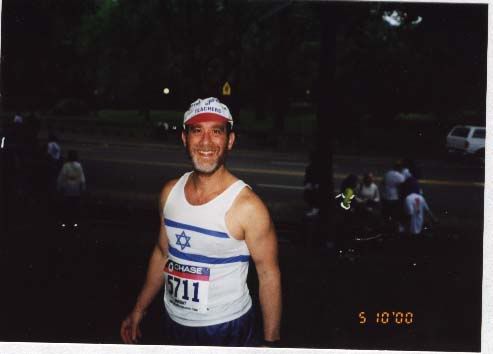
Two weeks ago I ran the New York City Half Marathon, consisting of one loop around Central Park, then south on Seventh Avenue to the storied 42nd Street, west to the West Side Highway and south to a festive finish at Battery Park, in the shadow of New York's Holocaust Museum. Since we assemble at the start when it is still dark, I packed my tallit and tefilin in the bag that was transported to the finish by the volunteers of United Parcel Service, to be used after I finish. I ran the race in a shirt that I custom made for the purpose, not as difficult a task as it sounds.


The picture, which I first saw in the movie Night and Fog, shows bodies bulldozed into a mass grave at Bergen-Belsen.

Below the picture is the verse from Yehezkel, read on Shabbat

Hol Ha-Moed Pesah: SHALL THESE BONES LIVE? The answer, God's answer to our generation, was on the back of the shirt - the flag of Israel. This nevuah (prophecy) became the basis of a Negro spiritual that, sadly, too few of us ever heard of. Praise God we live in a country where cross-fertlization of cultures is possible, but it can only happen if we don't shut ourselves off from the world. As I heard from somebody long ago, if you build walls instead of bridges don't complain when you find yourself alone on the other side.


After finishing the race and claiming my bag, I left the festivities and made my way to the museum. I davened in a secluded alcove with benches, and then entered the museum itself. Ever since the museum opened, I would make a running pilgrimage in summer wearing a shirt with the Israeli flag on it. When I run the NYC Half (you have to be picked in a lottery to get in) I combine my visit with the race, visiting the museum in the sweaty glow of Jewish strength, with my race number still attached to my shirt, the irony not lost on me or, I hope, on other visitors who knew survivors with numbers tattooed on their arms. The museum consists of a permanent core and, since an additional wing was built, special temporary exhibits. One time I learned about the agricultural colony at Sosua in the Dominican Republic, the only country in the Western Hemisphere that welcomed Jewish refugees from Hitler. This time I had the privilege of viewing an exhibit on Jewish university professors who escaped from Germany and found positions in historically black colleges in the southern United States. Having known what it is to be a pariah and to experience persecution, those scholars formed a unique bond with their black students in the Jim Crow South. I then visited the core exhibit, making my usual stops at the Sifrei Torah that sit open in glass cases. The scrolls, as I learned from a museum educator who spoke at my shul several years ago, are pasul, damaged beyond repair and unfit for public reading, and therefore it is halakhically permissible to leave them open in that manner. Just the same, I am bothered by the idea of leaving an open Sefer Torah in a glass case to be gawked at. The Nazis intended to do just that and exhibit those scrolls in a "museum of an extinct race" in Prague. I therefore make a point of stopping at each one and reading a few verses with the traditional tune, dressed not for shul in a jacket and long pants, but davka as a Jewish athlete in the glory of summer, in short pants and a sleeveless top, my strong Jewish muscles out there for all the world to see. Extinct race, huh? That is my answer, and my own personal thumb in Hitler's eye. I am 57 years old and my running times are nowhere near what they used to be. I don't know for how long I will be able to run this race or make this pilgrimage, but I don't plan on going gently into the good night.

Labels: , , , , , ,

Monday, February 23, 2009

The Story That Never Tires of the Telling

The Jewish Press (link) recently published an essay by Christopher Buckley, son of the late conservative thinker William F. Buckley, on his visit to Auschwitz. The essay was written in 2001 but not published until now, when the author admirably went public in response to Bishop Richard Williamson's brazen Holocaust denial (no one was gassed in Auschwitz, yeah right). I must have read literally hundreds of such accounts, but every time the story feels fresh. Most of these pieces are written by and from the point of view of survivors, sometimes their childen or grandchildren. I remember hearing Lt. Col. Walter Fellenz, a non-Jew, tell of his experiences liberating a camp. And every time I ask myself what every Israeli boy (I was born and raised here in the U.S.A.) who lived through the Eichmann trial asked his parents: How could you possibly let this happen? Why in heaven's name didn't you fight? I heard all the answers. Nothing like the Holocaust had ever happened in human history and people didn't believe what they were hearing. They were so isolated that they simply didn't know until it was too late, especially with the Germans being careful to disguise the reality. They thought they were going to take a shower until the doors shut. They were systematically starved and decimated by disease, so that they were physically incapable of resistance. They remembered the Germans of World War I as fairly decent people who brought civilization and actually liberated them from Eastern European anti-Semites. This wasn't the first time Jews were persecuted; the madness will end like the Cossack massacres and the Crusades did. The Jews who did put up a fight did so with superhuman valor; the Warsaw ghetto held out in 1943 longer than all of Poland did in 1939. Above all, 2000 years of exile sapped our will to fight or, to paraphrase Nietzsche, turned our men into women. I've heard it all and nothing satisfies. And so, reading about it for the umpteenth time, but this time written by a Gentile named Buckley, I asked myself again: Could the Nazis have murdered [Buckley uses the word murder, not exterminate; one exterminates cockroaches and rats] six million Irish? The question is tragically laughable. Irishmen would have torn the S.S. limb from limb. They don't call them the Fighting Irish for nothing. So I finished reading and I cried. Then I went downstairs and lifted weights.

Any wonder then that when people talk of the magnificent Torah life of pre-war Eastern Europe, I am filled with unrelieved disgust. I have absolutely no desire to resurrect a culture and a way of life that perished - literally went up in smoke - because we were too weak to defend it. Give me the Torah of Tanakh, the Torah of Joshua, Samson, King David and the rest (ever noticed how Tanakh is played down in the haredi yeshiva world?), normal Jews living normal lives in a normal country. Or give me nothing at all.

Labels: , , , , , , , ,

Sunday, January 04, 2009

For Hamas - A Flood of Fire

A flood of water you won't bring, but a flood of fire you will - Bereshit Rabbah

Noah's flood came to the world because it was "full of hamas." The word has been translated as corruption, violence, lawlessness and words of that ilk. Rashi calls it gezel - robbery. The current regime in Gaza certainly fills the bill. Their government, if you can call it that, has been utterly corrupt, violent and lawless. Hamas exists for one reason only - not to make life better for the people of Gaza but to destroy Israel. It makes no secret of its raison d'etre. Three years ago Israel handed Gaza to Hamas on a silver platter and what did it get in return? Daily rocket attacks on Sderot, and now as deep as Beersheva. Hamas is, as New York City's Mayor Mike Bloomberg put it, a wholly owned subsidiary of Iran. Iran is supplying Hamas with longer range missiles, smuggled in through tunnels from Egyptian Sinai, and is training Hamas operatives in their use. The only thing surprising about this is that anybody is surprised. Should Hamas suddenly get the warm and fuzzies for Israel now that they have a territory to govern? Of course not. When you show evil men that evil pays off, they intensify their evil. Finally, Israel decided that enough was enough, and set out to put an end to Hamas' attacks. Predictably, the world is outraged - not at Hamas but at Israel. Disproportionate! Civilian casualties! Suffering Palestinians! Not a word about Israeli civilians deliberately targeted by the beasts from Gaza. As usual, the world is cool with suffering weak Jews, but when we are strong and use force to defend ourselves, oy vey. And what would the United States, France, Russia or any nation on earth do if its population was subjected to daily lethal fire from across a hostile border?

What you won't find on the front page of the New York Times or in pronouncements emanating from the United Nations or the "Quartet" is that Israel, true to form, goes far out of its way to avoid civilian casualties and to alleviate the suffering of Arabs in Gaza. I never cease to be amazed at how Israel is willing to sacrifice its own soldiers and civilians to spare those of the enemy. Before bombing an area, they warn residents to leave. Of course, that tells Hamas to move their rocket launchers elsewhere, so that attacks on Israel's population centers actually increase. The folly of Lebanon 2006 is repeated. Humanitarian aid - food, medicine and such - is shipped by Israel into Gaza - all while a war is going on! Never mind that most of it will doubtless find its way to Hamas' "fighters," and not to the poor suffering Gazans that Hamas uses as human shields. Can you imagine the United States sending food and medicine into Tokyo or Berlin during World War II? The Israelis have gone mad! They say that Arabs in Gaza are not the enemy, that in fact they are victims of Hamas as much as the citizens of Sderot, and now Ashkelon, Ashdod and Beersheva. Nonsense! Who put Hamas in power by as democratic an election as there could be in any Arab country? Who allows Hamas to put rockets and other military assets in schools and private homes, so that when Israel attacks civilian casualties are unavoidable? The entire population of Gaza is Amalek. All are culpable, just as the entire German population aided and abetted Hitler and deserved whatever befell them and then some.
Instead of doing everything in its power to minimize the population's suffering, Israel should put the fear of God in the Arabs of Gaza, impressing on them in the only language they understand that cooperating with Hamas is bad for their health. It should be making life for Arabs in Gaza so miserable that many will be motivated to leave the country.

Israel does seem to have learned a lesson from the debacle in Lebanon and from America's experience in Iraq: Air power prepares the battlefield but only boots on the ground and plenty of them can secure it. Ground troops are entering the vipers' nest that is Gaza City and the surrounding refugee (for 60 years!) camps. Ferreting out Hamas' men, rockets, launchers (very small and portable) and other equipment by going house-to-house will no doubt be costly in Israeli lives. The alternative is a public relations nightmare, but one I would prefer to a slow slog through unfamiliar and hostile back alleys. War is not an exercise in public relations, and is to be resorted to only when all other alternatives (short of national suicide!) are exhausted, as they are here. When war is necessary, you have to go whole hog. If any house, school or hospital in Gaza City can contain weapons aimed at Israel, then Israel may, and perhaps must, do a Dresden on Gaza City. Flatten the place. Burn it to the ground. Leave not one stone on top of another. Bake Hamas' men in the smouldering ruins of their city. Then send in the troops to mop up, dispose of the corpses and clear the remaining weapons. To paraphrase British Air Marshall Arthur Harris, all of Arab Gaza is not worth the life of one Israeli soldier. Hamas will have brought on itself a richly deserved "flood of fire."

And then what? When Gaza was liberated in 1967, Prime Minister Golda Meir announced that Gaza was a dagger pointed at Israel's heart and could never be given away. She was not known as "the only man in the cabinet" for nothing. Foolishly, Israel did give it away - and look what it got in return. Now Israel protests that it does not want to return to Gaza, only to destroy Hamas' operational capability. But what do they think will happen as soon as they leave? Hamas will rebuild, with the help of its sugar daddy Iran. Just like Hezbollah did in Lebanon. What would Germany and Japan have done if the victorious Allies had left them to their own devices? Return permanently is just what Israel has to do, and the displaced Jews of Gush Katif will be only too willing to go back and make the place bloom like they did before 2005.

And we? As happens whenever Israel goes to war, we are feeling frustrated. We want to help, but don't know how. Some suggestions:
1. With God's help, nothing is impossible. Say extra Tehilim (e.g. 20, 27, 83, 121, 130).
2. If you have a child studying or volunteering in Israel, do not beg him to come back. His/her place is there.
3. If you were planning a visit, go through with it. No one can guarantee that you will not come to harm, but no one can guarantee that in Brooklyn either. I traveled all over Jerusalem without incident but got mugged on my own block. If a place is particularly dangerous, the Israeli police and military will seal it off, so you might not be able to ride to Kever Rahel and Hevron in that armored bus.
4. Any number of charities funnel our tax deductible dollars to where they are needed most. Among them are:
Magen David Adom
Friends of Israel Defense Forces
A Package From Home
Pizza IDF (honest, they deliver pizza to isolated army units)
5. With Israel's resources stretched to the limit, hasbara has to take a back seat. Articulate, educated Jews like us can take up the slack. Attend demonstrations, write letters to the media, and when the casualty figures and ugly scenes appear on the television news, remind the squeamish of the casualty figures of World War II and the tactics used, and of what the world would be like if God forbid the other side (sitra ahara) had won.

May this be the last of Israel's wars and may next year see us celebrating with Mashiach in the rebuilt Beit Hamikdash.

Labels: , , , , , , ,

Friday, November 21, 2008

Gam Zu L'Tova - 3

Agriprocessors. The largest kosher beef slaughterhouse and processing plant in the country. Revitalized the economy of moribund Postville, Iowa and became its largest employer. Featured in Jewish Action and other publications. Then suddenly the whole house of cards crumbled. Federal immigration agents raided the place and arrested hundreds of illegal immigrant workers. Allegations of child labor and unsafe working conditions resulting in loss of fingers in some cases. Production crippled due to a shortage of workers. Finally the operation filed for bankruptcy. Retail butchers around the country face severe shortages of meat. Other kosher plants try to take up the slack but lack the production capacity.

Eventually the situation will get back to normal. Either Agriprocessors will successfully reorganize, another kosher producer will buy and operate the plant, or existing kosher suppliers will expand their operations and entrepreneurs will enter the field figuring to make a buck. But until then we will be thinking about where our meat comes from, whether we need to eat so much of it, or any at all, and whether the kosher meat industry as presently constituted is consistent with Jewish ethics.

Agriprocessors, like most American meat processing plants, was based on "factory farming." A factory farm has little to do with the family farms that used to be the backbone of American agriculture or the farming practices described in Tanakh. On a factory farm an animal is a production unit first, and a living, sentient organism a distant second. Male animals are castrated and shot full of female hormones so they could grow faster, but the growth is mostly fat. Cattle, which naturally eat grass, are fed grain instead, again for accelerated growth, but this unnatural diet makes them sick. They are packed into feedlots, wallowing in their own filth, which also makes them sick. The animals are then fed antibiotics to which the infecting pathogens develop resistance, which is transfered to human pathogens. Any number of gastrointestinal outbreaks have been traced to factory farms. It is an understatemet to say that factory farming practices raise issues of tza'ar ba'alei hayyim, unnecessary suffering of sentient animals. It also raises more mundane issues of kashrut. A modern slaughterhouse is an assembly line, where profit is maximized by processing the largest number of animals in the shortest amount of time. Can a shohet pay as much attention to the condition of the knife and the exacting technique of shehita as he could on a family farm where he could take as much time as he needed for each individual shehita? Clandestine video taken at Agriprocessors shows ghastly suffering from what looks to the layperson's eye like massively botched shehita. Granted, the video was taken by People for the Ethical Treatment of Animals (PETA), a group hostile to shehita in general and not especially concerned with ethical treatment of humans if they happen to be Jewish. But pictures don't lie, and living cows writhing in pain with their trachea and esophogi hanging out is inconsistent with Jewish values, if not with halakha.

Now, for the time being, factory-farmed kosher beef will be in short supply. What there is of it will be much more expensive, due both to supply and demand and to the rising cost of animal feed and transportation. Cash-strapped Jewish families will be eating less beef, and that will be to their benefit. Factory-farmed beef is much fatter than what our stone-age ancestors hunted down on foot with primitive weapons, and fatter than livestock raised before the advent of farm machinery. All that fat is unhealthy and a major contributing factor to obesity and its sequelae. In my family we eat beef very rarely; we eat chicken (much leaner than factory-farmed beef) on Shabbat and holidays, and vegetarian fare during the week. Thank God I am a healthy and vigorous 56, at an age when my father's health began to fail, as is that of many of my carnivorous contemporaries.

We are now in a position to insist that our beef be raised sustainably, in a manner consistent with the animals' well-being and our own, fed mostly on grass, with a minimum of fertilizers and pesticides. The operation will be less profitable, and less beef will be produced. What used to be on the menu every day if not twice a day will become a treat for Shabbat and Yom Tov. And we will all be better off for it.

Labels: , , , , ,

Friday, July 04, 2008

A Parsha Thought - Hukkat

Tomorrow we will read my Bar Mitzva Parsha - Hukkat. From Korah's rebellion in last week's Parsha we skip some 38 years, and are now in the last year of wandering in the desert. We travel around Edom since they did not allow us to pass through their land and we were forbidden to wage war against them. Next we came to Sihon and Og, two powerful Amorite kings charged with barring our way from Canaan. Both were soundly defeated, their land conquered and made part of Eretz Yisrael. We know from last week's haftara that the inhabitants of Canaan, on the opposite (west) side of the Jordan, had heard of kri'at Yam Suf and of the destruction of Sihon and Og and had completely lost their confidence and will to fight. That the miraculous splitting of the Sea of Reeds would frighten our enemies is understandable, but that happened 40 years ago. The victories over Sihon and Og were fresher, and seem to have made the panic in Canaan even stronger - for good reason. The splitting of the sea was a miracle, and perhaps the murmurings, rebellions and debauchery with the women of Moab made us unworthy of such miracles in the future. But the victories over Sihon and Og were, to all appearances, not miracles. No stretching forth of the rod, no raising hands to heaven, only a conventional war. Tremendous hiddush for the Canaanites - those Jew boys can fight! And that must have scared the pants off them! Ken tihyeh lanu; may the same come to pass for us.

The haftara that I read is one of the longest, and contains an important lesson for our own time. Yiftah, the judge of Israel, was faced with a warlike neighbor Ammon. He sent diplomats to Ammon, and they came back with a demand that Yiftah "return" some territory on the East Bank (yes, the East Bank) of the Jordan that Israel had taken some 300 years previously. Return the territory, and you can have peace. Yiftah replies that the land in question was not taken from Ammon (as with Edom, the Torah forbids us to start a war with Ammon or Moab) but from Sihon and Og. He goes on to tell the king of Ammon that what his idol Kemosh (actually the idol of the related Moabites) gives him he can keep, and what Hashem gives us we will keep. One can only surmise that Yiftah was using diplomatic language; surely he knew that Ammon's idol gives them nothing, and the same Hashem that gives us what is ours gives the Ammonites what is theirs. In any case, Yiftah lets the king of Ammon know that he will not "return" a square centimeter, and if the king is intent on war, bring it on, b'ezrat Hashem we're ready. Naturally, a war ensued which we won. No more trouble with the Ammonites for a long time. Show weakness to our enemies and they pounce on us, demanding more and more "concessions." Show strength, and with God's help we will overcome.

Hat tip: Rav Meir Kahane hy"d

Labels: , , , , , ,

Sunday, June 08, 2008

Yom Ha-bikkurim

We are about to celebrate Shavu'ot, and many of us will stay up all night learning Torah. Tomorrow we will hear the Ten Commandments in shul, and refer to the holiday in the Amida as "z'man mattan torateinu" - the time of the giving of the Torah. But if we look in the Torah shebikhtav, there is no mention of Shavu'ot as commemorating the giving of the Torah. Torah was supposed to be as fresh and new every day as the day it was given. And indeed, Shavu'ot is the only holiday that does not have a fixed date on the calendar. It is celebrated seven weeks after the second day of Pesah. Before the adoption of a fixed calendar in the fourth century C.E., each month had either 29 or 30 days depending on when witnesses saw the new moon in Jerusalem; one never knew in advance how many days a month would have. Depending on whether Nisan and Iyar had 29 or 30 days, Shavu'ot could come on the fifth, sixth or seventh of Sivan. The seventh is the day of Mattan Torah only according to R. Yosi, and the fifth is not the day according to anybody!
The holiday is charcacterized in Torah shebikhtav two ways: Shavu'ot, since it occurs seven weeks after Pesah, and Yom Ha-bikkurim, the day when the first of the wheat crop was brought up to the Beit Ha-mikdash and given to the Kohanim. The Mattan Torah angle apparently is post-exilic, a cultural accretion that developed when we no longer had a Beit Mikdash and therefore could not bring Bikkurim.
Shavu'ot is also referred to in the Mishna is Atzeret, a conclusion. Just as Sh'mini Atzeret is the conclusion of Sukkot, Shavu'ot is a conclusion of Pesah. We've all heard, and most of us will hear again tomorrow or the day after, drashot explaining that the purpose of yetzi'at Mitzraim was fulfilled with Mattan Torah seven weeks later. Freedom without law is not freedom but chaos. Without detracting from this explanation, I would like to offer an additional one. As slaves our lives were not our own; we did what our masters told us to do when they told us to do it. Even our food was dictated by our masters, who set a pot of food in front of us the way one would feed animals (see the commentaries on sir ha-basar, the fleshpots of Egypt). The fruits of our labor belonged not to us but to our oppressors. As free men, our lives would be very different. We would have our own country, work its soil, and enjoy its produce. The temptation to attribute our success to our own efforts - kohi v'otzem yadi (see Parshat Eikev) must have been strong. Therefore, we were commanded to take the first fruits of each year's crop, bring it up to the Beit Ha-mikdash, and recite a confession which became the basis of the Haggadah Shel Pesah [see the beginning of Parshat Ki-Tavo]. But the Haggadah stops in the middle, after the miraculous deliverance from Egypt. The remaining verses are not read at the Seder: And He brought us to this place, and He gave us this land flowing with milk and honey. And now I brought the first fruits of the land that You, Hashem, gave me, and he [the one who brings the Bikkurim] shall leave it before Hashem your God and He shall bow down to Hashem your God. And he shall rejoice in all the good that Hashem your God gave you and your house. . . . Shavu'ot becomes the conclusion of Pesah, in that we confim our freedom by thanking Hashem for the privilege of working our soil and eating its produce, and acknowledge that our material success comes from Hashem! Is this the same people that developed a culture of parasitism where working for a living is denigrated and the ideal is to study Torah full time and live off the labor of others? If I had my druthers we would be reading Parshat Ha-bikkurim on Shavu'ot along with the Ten Commandments.

The Bikkurim were to be brought up in a basket, in Hebrew not the usual sal (as in kadursal, basketball), but a tene, a word that sounds Egyptian. A tene held things. It resembles a Latin root meaning "to hold," i.e. tenir in French. In English the word "tennis" originates from the racket that a tennis player holds in his hand, and Cold War defeatists told us that West Berlin was untenable, we couldn't hold onto it. I wonder if the Hebrew-Egyptian and Latin words are related, or if they simply resemble each other by accident. At any rate, in a good year the contents of a tene must have been heavy, and it had to be held in the hand at least the final few hundred meters to the Beit Ha-mikdash. Shavu'ot - Yom Ha-bikkurim was no holiday for Jewish weaklings!
Let us pray that we will soon celebrate Shavu'ot as we were commanded, as normal Jews in a normal country once did, with heavy baskets carried on strong Jewish shoulders to the rebuilt Beit Ha-mikdash, quickly and in our time.

Labels: , , , , , , ,

Sunday, March 16, 2008

Zakhor - Remember

Yesterday, the Shabbat before Purim, we read Parshat Zakhor, the exhortation to remember the sneak attack that Amalek carried out in the desert and, when we finish conquering Eretz Yisrael, to erase Amalek from under heaven. The haftara from Sefer Shmuel tells how the prophet Shmuel conveyed God's message to King Saul that the time for that punic war had arrived. In language that grates on our modern ears, he is commanded to utterly destroy Amalek, "from man to woman, from infant to suckling, from ox to lamb, from camel to donkey." The words offend our sense of right and wrong, and they did the same to King Saul. He thought he knew better than God what was right and what was wrong, so he spared Agag, the king of Amalek, and his wife. They conceived a child that night, and the Amalekite evil that should have been stamped out once and for all survived. Centuries later Agag's descendant Haman hatched the plot whose frustration we will celebrate this Friday. The biological descendants of Amalek may be gone, but the evil they represented is still very much with us, as we saw last week. An Arab terrorist, a citizen of Israel living in Yerushalayim, carried out a sneak attack against students at Yeshivat Merkaz Harav and murdered eight talmidim in the beit midrash. Like their forebears, this Amalekite did not dare fight us like men, but instead murdered unarmed Yeshiva students. Holy sefarim were stained with their blood. Like so many times before, young parents cried at the funerals of their children.


Remember - This is an enemy that glorifies the murder of innocent people, that celebrated this outrage just as it celebrated the murders of 9/11. Remember - This is an enemy that teaches its children to idolize and emulate suicide bombers. Remember - This is an enemy (same enemy, same fight) that flies planes full of innocent people into buildings full of innocent people. An enemy that chops off people's heads in front of rolling TV cameras to make political points. There is no barbaric outrage, no atrocity, no inhumanity that is beneath those cowards. Remember what the rest of the world, even much of America, prefers to forget. The following is a column from the New York Post a bit less than a year after the attack on the World Trade Center on September 11, 2001:


WHERE'S THE ANGER?
by Eric Fettmann

August 29, 2002 --
THE first anniversary of Sept. 11 fast approaches, and the ceremonies have been set: intense, commercial-free TV coverage of what promises to be simple, dignified, yet extremely emotional proceedings at Ground Zero.
But there's something missing.
We'll see the pain and the grief. We'll see the loss of widows and widowers, of children who lost parents. We'll see the uniformed services commemorating their comrades' heroism and sacrifice. But what has happened to our anger? The acute rage, the white-hot fury that nearly all Americans felt in the immediate aftermath of the horrifying murders of 3,000 people seems to have dissipated. And, with it, the resolve that saw Americans united on the need to utterly demolish international terrorism. Which is one reason why, increasingly, the skeptics are seizing control of the debate over how America should respond: They're ridiculing President Bush's rhetoric about the "axis of evil" and raising fears that confronting international evil is not worth U.S. casualties. It's almost as if we want to put the shocking memories out of our minds - even as we obsess over our loss with the kind of forlorn grief that we normally reserve for dead celebrities. To that end, the networks have promised not to air the sickening footage of the planes hitting the Twin Towers. I understand the pain that such video may cause those who lost loved ones in the carnage, but America - and the world - need to be reminded, as forcefully as possible, just what happened that morning. We need to see the footage again and again. We need to recall, vividly and acutely, the horror and the heartsinking fear we all felt that day.
Even from the outset, some details seemed too bloodcurdling to discuss. The New York Times, for example, was widely - and wrongly - criticized for publishing a large photo showing several victims jumping from the blazing towers. Consider how appalling the situation must have been up there that scores of people willingly jumped hundreds of feet to certain death in order to escape the flames. It enrages me just to think about it - and it should enrage everyone.
And yet the late-night talk-show hosts long ago began working Osama bin Laden jokes into their monologues. The murderer of 9/11, with the blood of thousands of innocent people on his hands, has become grist for the nightly joke mill. Even David Letterman, whose stunned and tentative demeanor on his first post-9/11 show captured the national mood like nothing else, sees no reason not to make jokes like this one the other night: "Osama bin Laden is back running al Qaeda. I guess this means their leader got back from vacation before our leader."
We've grown so obsessed with the monthly ceremonies and the size of the permanent memorial, as psychobabblers run around seeking "closure" for the survivors and the families, that we've forgotten just what bin Laden unleashed on this country.
Has our national attention span really become so short? I'm sorry, but I don't want to see mournful processions and bagpipes playing "Amazing Grace" over and over. I want to see a rekindling of the unrestrained anger we once felt. I've seen conservatives rage for years about Bill and Hillary Clinton. I've seen liberals who still can't discuss the 2000 elections without uncontrolled fury. Why don't we still feel the same way about bin Laden?
I also want to see the same determination to vanquish the enemy that Americans displayed 60 years ago when 2,300 of our countrymen were murdered at Pearl Harbor. On Dec. 7, 1942 - the first anniversary of what was still angrily being called Japan's "sneak attack" - The Post's headline was: "Wrathful City Marks Pearl Harbor Day With Grim Resolve." The editorial page said, "The test of character of a man or a nation" is "how he pulls himself off the floor and slugs his way toward victory."
Can we honestly say that 9/11 has done the same thing for us? Yes, taking drastic action on the basis of unrestrained emotion can be dangerous. More often than not, it's necessary to step back a bit and gain some perspective.
But it's just as dangerous when the pendulum of emotion swings to the opposite extreme - and we forget what and why we are fighting.
Ad kan leshono.

Remember - and keep reminding our friends, neighbors, co-workers and countrymen who would rather forget. Remember - and support the political candidates who remember, and oppose those who would rather forget. Remember - and do what has to be done.
Erase those evil bastards from the face of the earth. Never mind collateral damage. Never mind the cost - diplomatic, economic and military. Full speed ahead and damn the torpedoes. Erase them. It's either them or us.


NEVER FORGET

Labels: , , , , , , ,

Wednesday, November 28, 2007

For one brief shining moment. . . .

President John F. Kennedy was assassinated 44 years ago on November 22, 1963 (6 Kislev 5724). For those old enough to remember, and I was eleven years old at the time, the day conjures up powerful emotions. It was a loss of innocence; such things were supposed to happen in rinkydink banana republics but not in America. The grief was indescribable; grown men cried openly, in the street (to be sure, our Tanakh is chock full of men crying, but it violates a strong Anglo-Saxon taboo). We know exactly where we were and what we were doing when we got the news. I was in my sixth-grade classroom checking my Think-and-Do Book (the reading workbook just about every kid in America used in the 1950s and early ‘60s) when Rabbi Harry Halpern, headmaster of East Midwood Day School, walked into the classroom and announced that President Kennedy was in the hospital in critical condition following an assassination attempt. Dispensing with the loudspeaker system, he made the same announcement personally to every class in the school. Rabbi Halpern left the class in pandemonium. The teacher tried to get us back to the Think-and-Do Book but nobody was thinking; we were just doing by rote. I was crying so badly that the teacher had to send me out of the room. Soon the bell rang and we went downstairs to the art room. On the way we saw Rabbi Halpern again, and he said simply, “It’s all over.” It was Friday, so we came home and made a gloomy Shabbat. On Monday school was closed and we watched the state funeral on our black-and-white twelve-channel TV.
Somehow we and the country carried on, and perhaps it was inevitable that revisionist history would debunk the legend that had grown up around President Kennedy when he was still alive, but I remember him as a truly great President, the like of which is rarely seen. For one thing, he was young, in a country that had been led by old fuddy-duddies for decades. He had two little children, and we thrilled to little John-John toddling around in the oval office. The touch football games with his brother Robert on the White House lawn also struck a chord in us. He wanted every American child to have one period a day of physical activity in school; today kids are lucky to get one period a week. If we had followed his advice we would not have fat little kids with Type 2 diabetes today.
We were engaged at the time in the Cold War with Soviet Communism, and the Soviet leader Nikita Khrushchev thought the young new President would be a pushover. He tested President Kennedy in Berlin, giving him an ultimatum to evacuate West Berlin, an island of freedom surrounded by Communist East Germany and a thorn in the Soviets’ side. Kennedy did not back down, and the Communists built the infamous Berlin Wall to keep their miserable people from escaping to freedom. The President would be tested again in the fall of 1962, when Khrushchev stationed offensive nuclear missiles in Communist Cuba, ninety miles from home. Kennedy faced the Russians down, guiding us to the brink of nuclear war and back. Khrushchev blinked and withdrew the missiles. Perhaps not surprisingly, Khrushchev acquired some respect for our young and vigorous leader, and the following summer he and Kennedy negotiated a limited nuclear test ban treaty, which banned nuclear tests in the atmosphere that up to then had been spewing carcinogenic strontium-90 and other radioactive poisons into the air.
The President was helped in his conduct of foreign policy by a patriotic spirit rarely seen nowadays. America was right and good, Communism was evil, and Communists were the enemy. Opinion leaders and the entertainment industry were not actively engaged in tearing America down like they are today, when we are similarly engaged in a titanic struggle with an implacable enemy totally committed to destroying us.
Before he became Presient, Kennedy wrote a book, Profiles in Courage, that should be required reading in any American history course. In it, he profiles several political figures who went against their constituents’ wishes to do what they believed was right, even though they stood to suffer politically for it. For instance, Texan patriot Sam Houston refused to take the oath of allegiance to the Confederacy when Texas seceded from the union. As President, he became a remarkable profile in courage himself. His greatest act of courage was on the domestic front. As difficult as it is (thanks to him) to believe these days, the American South at the time was essentially an apartheid country. American citizens with dark skin could not attend the same schools, be served in the same restaurants, even drink from the same water fountains as white Americans. President Kennedy ordered federal troops to carry out the court-ordered integration of the all-white Universities of Mississippi and Alabama. Following on that, he sent to Congress the most sweeping civil rights legislation since Reconstruction. He was taking the country where it was not yet ready to go, and the South reacted violently. The legislation in fact was not passed until after his death, but today it is hard to believe that Jim Crow, as apartheid in America was called, ever existed.
Due to his youth and vigor, President Kennedy was something of a father figure to Americans (pater patriae). And every year on November 22 I feel like I have yahrzeit.
Of course there is no halakhic significance to the day, but my mood is one of aveilut. I say extra Tehilim, avoid entertainment and listen only to appropriately themed music such as Leonard Bernstein’s Kaddish Symphony (which was completed on the afternoon of November 22, 1963 as the news broke). Tears still come, but being a dyed-in-the-wool American male I suppress them. Devout Christians facing a difficult decision often ask themselves, “What would Jesus do?” When I have to take a political position or perform a task requiring moral courage, I ask myself what JFK would do. I have little doubt that he would persevere and see our struggle to stay free through to victory.

Labels: , , , ,