Birds of a feather flock together
It seems the Iranians are also steamed up about the Internet, and their rantings sound eerily like those of the haredim. Click on this link:
http://news.yahoo.com/iran-swipe-brings-angry-reply-184348436.html
Iran swipe at Web brings angry reply
Iran greets outcry over Web squeeze with fresh promises for Tehran-centric cyberworld
http://news.yahoo.com/iran-swipe-brings-angry-reply-184348436.html
Iran swipe at Web brings angry reply
Iran greets outcry over Web squeeze with fresh promises for Tehran-centric cyberworld
Associated Press -
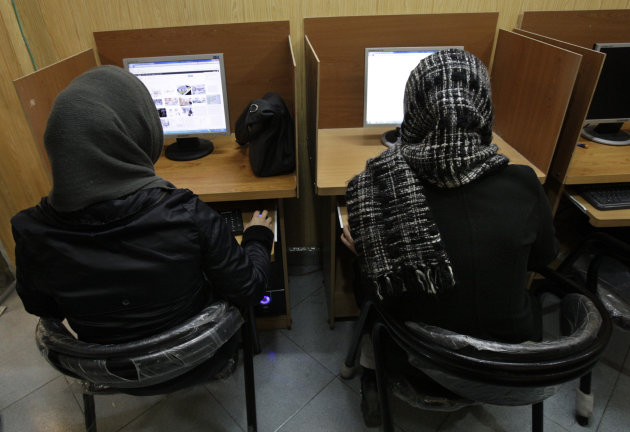
FILE- In this Monday, Feb. 13, 2012 file
photo, Iranian women use computers at an Internet cafe in central Tehran. Iran’s
cyber monitors often tout …more their efforts to fight the
West’s 'soft war' of influence through the web, but trying to ban Google’s
popular Gmail may have gone too far with complaints coming even from
email-starved parliament members. (AP Photo/Vahid Salemi, File)
TEHRAN (AP) -- Iran's cyber monitors often tout their
fight against the West's "soft war" of influence through the Web, but trying to
block Google's
popular Gmail
appeared to be a swipe too far.
Complaints piled up — even from
email-starved parliament members — and forced authorities Sunday to double down
on their promises to create a parallel Web universe with Tehran as its center.
The strong backlash and the unspecific
pledges for an Iran-centric Internet alternative to the Silicon Valley powers
and others highlight the two sides of the Islamic Republic's ongoing battles
with the Web. It's spurred another technological mobilization that fits neatly
into Iran's self-crafted image as the Muslim world's showcase for science,
including sending satellites into orbit, claiming advances in cloning and stem
cell research and facing down the West over its nuclear program.
But there also are the hard realities of
trying to reinvent the Web. Iran's highly educated and widely tech-savvy
population is unlikely to warm quickly to potential clunky homegrown browsers or
email services. And then there's the potential political and economic fallout of
trying to close the tap on familiar sites such as Gmail.
"Some problems have emerged through the
blocking of Gmail," Hussein Garrousi, a member of a parliamentary committee on
industry, was quoted Sunday by the independent Aftab-e Yazd daily. What he
apparently meant was that many lawmakers were angry and missing their emails.
He said that parliament would summon the
minister of telecommunications for questioning if the ministry did not lift the
Gmail ban, which was imposed last week in respond to clips on Google-owned
YouTube of a film mocking the Prophet Muhammad that set off deadly protests
across the Islamic world.
Even many newspapers close to the
government complained over the email disruptions. On Saturday, the Asr-e Ertebat
weekly reported that Iranians had paid a total of $4.5 million to purchase proxy
services to reach blocked sites, including Facebook and YouTube, over the past
month.
Iranian authorities — perhaps recognizing
the risks at hand — decided against taking a symbolic twin shot at Google and
cut access to the Web browser in a country with 32 million Internet users among
a population of 75 million, according to official statistics.
That would rank online Iran among the
world's top 20 in terms of sheer numbers of users, and equivalent to some
European countries in per capita Web use at more than 40 percent, according to
the private monitoring group Internet World Stats. The World Bank, however, puts
Iran's Internet link rate at just 21 percent last year.
The U.S. is among the world's highest at more than 75 percent.
Iran's deputy telecoms minister, Ali Hakim Javadi, told reporters that
Iranian authorities were considering lifting the Gmail ban. But he also used the
opportunity to again promise development of Iran's domestic alternatives: the
Fakhr ("Pride") search engine and the Fajr ("Dawn") email, Aftab-e Yazd
reported.
When reporters noted the quality of Gmail services, Javadi quipped: "If there
is Mercedes Benz on the street, that doesn't mean everyone drives a Mercedes."
Iran's clerical establishment has long signaled its intent to get citizens
off of the international Internet — which they say promotes Western values — and
onto a "national" and "clean" domestic network. Earlier this year, Iran's police
chief, Esmail Ahmadi Moghadam, called Google an "instrument of espionage" rather
than a search engine.
But it is unclear whether Iran has the technical capacity to follow through
on its ambitious plans, or is willing to risk the economic damage and the social
shock waves.
The Internet has steadily become part of Iran's fabric since the first
Farsi-language sites developed a decade ago by Canadian-Iranian blogger Hossein
Derakshan, who is considered one of the founders of Iran's social media
community. Derakshan, however, was detained in 2008 and sentenced to nearly 20
years in prison two years later as the battles heated up between liberals
seeking open access to the Web and authorities trying to erect their own version
of China's "Great Firewall," the name given to Beijing's extensive filtering and
censorship of the Internet.
Sites such as Twitter and Facebook were
pillars of the street revolts after the disputed 2009 re-election of President Mahmoud
Ahmadinejad. The powerful Revolutionary Guard responded by recruiting and
training its own cyber force to patrol the Web and, later, try to defend against
virus attacks on nuclear and other sites that Iran has blamed on the West and
its allies.
Some Web security experts also have raised the possibility of Iranian hackers
being behind some recent high-profile computer attacks, such as disruptions at
Saudi Arabia's state oil giant Saudi Aramco and Qatari natural gas producer
RasGas earlier this month. Iran has denied any links.
In a video message for Iranian new year in March, President Barack Obama
denounced what he called the "electronic curtain" that keeps ordinary Iranians
from reaching out to Americans and the West.
A few weeks later, Supreme Leader Ayatollah
Ali Khamenei ordered the creation of an Internet oversight agency that included
top military, security and political figures in the country's boldest attempt
yet to control the Internet. The panel is headed by Ahmadinejad and includes
powerful figures in the security establishment such as the intelligence chief
and the commander of the Revolutionary Guard.
It's not Iran's first attempt to hold off
what hardliners call a Western "cultural invasion." The so-called Barbie wars
have gone on for more than a decade with periodic raids to confiscate the iconic
American dolls from toy stores. Iran also introduced its own dolls — twins Dara
and Sara — designed to promote traditional values with modest clothing and
pro-family values, but it hasn't significantly dented the demand for Barbie
dolls.
___
It will be remembered that certain haredi elements, notably Neturei Karta, make buddy-buddy with the Amalekim of Teheran who seek to destroy us. Perhaps the haredim will invite a contingent of Iranians to their next confabulation at Citi Field. Or maybe it won't be necessary. I have a message for them: Take your bans, your broadsides and your filters and hop a plane to Iran. American planes don't go there? I'm sure you can get connections by way of Cairo or Damascus. Or maybe take a plane to Uman, Lizhensk or any of the stinkholes of Eastern Europe that your parents and grandparents came crawling out of and recreate your pre-Holocaust world of insularity, ignorance and weakness, physical and mental. To the Rabbinical Council of America: Quit looking over your right shoulder and grow yourselves a pair. Defend intellectual freedom whenever and by whomever it is under attack.
Iran, Communist China and the Orthodox crazies can keep their narrow world view. We want no part of it. We march confidently forward, backs straight and shoulders square, to meet the approaching ge'ula. May it go to completion swiftly in our time.
Murphy reported from Dubai, United Arab
Emirates.
It will be remembered that certain haredi elements, notably Neturei Karta, make buddy-buddy with the Amalekim of Teheran who seek to destroy us. Perhaps the haredim will invite a contingent of Iranians to their next confabulation at Citi Field. Or maybe it won't be necessary. I have a message for them: Take your bans, your broadsides and your filters and hop a plane to Iran. American planes don't go there? I'm sure you can get connections by way of Cairo or Damascus. Or maybe take a plane to Uman, Lizhensk or any of the stinkholes of Eastern Europe that your parents and grandparents came crawling out of and recreate your pre-Holocaust world of insularity, ignorance and weakness, physical and mental. To the Rabbinical Council of America: Quit looking over your right shoulder and grow yourselves a pair. Defend intellectual freedom whenever and by whomever it is under attack.
Iran, Communist China and the Orthodox crazies can keep their narrow world view. We want no part of it. We march confidently forward, backs straight and shoulders square, to meet the approaching ge'ula. May it go to completion swiftly in our time.
Labels: America, courage, haredim, Holocaust, internet, manliness, Modern Orthodox
posted by Zev Stern at 5:10 PM
1 comments