A New Year - A New Mayor
An era ended two
weeks ago for New York City. Twenty
years of Republican mayors are over and for the first time in a long time this
city, where registered Democrats outnumber Republicans four to one, is being
governed by a Democrat, a Democrat for whom I voted with much hope and
confidence. When I vote for Republicans,
which I do more often than I’d like, I vote for them with a heavy heart,
knowing that if they win I and other liberals (there, I just said the L-word)
would have to watch them like a hawk. We
are coming off eight years of Rudy Giuliani and twelve of Michael
Bloomberg. Their record is mixed, but
far more positive than I would have expected from Republicans. Giuliani entered City Hall with a city awash
in crime and a deteriorating infrastructure whose middle class tax base was
leaving in droves. We all were resigned
to double locking our doors, driving our cars in summer with windows locked and
gas-guzzling air conditioners at full blast, and not letting our children out
of our sight in a city which we simply assumed was ungovernable. After Mayor Giuliani’s first term the city
had done an about face. Crime rates were
the lowest in memory, children played outside, and we still double locked our
doors but more from force of habit than fear of actual danger. The city was never ungovernable; it was
merely ungoverned for too darn long.
Giuliani appointed several get-tough police commissioners and a novel
“broken windows theory” of policing; sweat the small stuff and you don’t get
the big stuff. Arrest petty vandals,
grafitti “artists,” turnstile jumpers and such and they don’t graduate to armed
robbery, rape and murder. At the first
sign of any trouble in Crown Heights, which suffered a terrible pogrom a year
and a half before Giuliani took office,
a phalanx of riot-equipped police with a mobile command post and the
whole nine yards descended on the neighborhood and did not leave until the
trouble was over. Cynical New Yorkers
pooh-poohed the new policies but they worked.
Serious felonies took a nose dive and there were no Crown Heights riots
in Crown Heights or anyplace else. The
City became a safe place to live and work, the exodus to the suburbs ended and
people who had fled actually started coming back; there is little to recommend
a long automobile commute on snowy highways and with gasoline prices sky
high. Freshly minted energetic and
creative college grads flocked to New York and reinvigorated deteriorating
neighborhoods like North Williamsburg, the Lower East Side and even Harlem.
Giuliani’s second
term brought still more reduction in crime, but there were stirrings of too
much of a good thing. Law-abiding people
were being gratuitously harassed by the police, some of whom seemed to actually
enjoy harassing them. Being a teacher in
an inner-city school, I would overhear the horror stories of students and
teachers of color about being randomly stopped by cops and asked for ID (which
no American civilian is required to carry), thrown up against a wall,
invasively searched without a warrant, and the like. Certain neighborhoods in the City were
turning into a police state and affluent New Yorkers who held the power didn’t
seem to care. You did not even have to
be black to be harassed by Giuliani’s cops; it happened to me. I was attending teachers’ meetings in a high
school in Bensonhurst, and was running north at lunch time to a kosher Dunkin
Donuts to grab a bite when I was stopped by two people. They asked me what I was doing in the
neighborhood. Being Jewish I answered
their question with another question: What’s it of your business? They showed me shields that identified them
as police and resumed their intrusive questioning. When I told them that I was in the
neighborhood for teachers’ meetings at the high school, they told me the
schools were closed for Election Day. I
replied that the schools are closed for students, but teachers have meetings
and they can check that with the Board (now the Department) of Education. What do you know about drug dealing over
there (pointing south toward Coney Island)?
I don’t know what you’re talking about.
Why are you running? I like to
run. They looked at me like I was
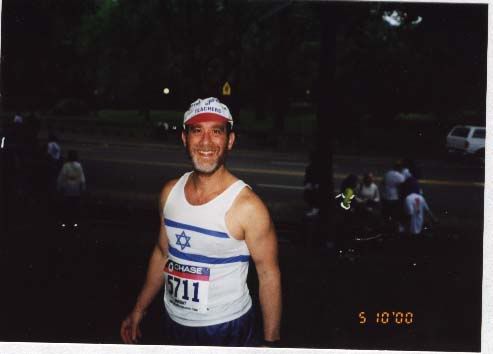
crazy. Never mind that I was wearing a
baseball cap emblazoned on both sides with “New York City Marathon” and it was
the week before the Marathon. What
freaking planet were those guys on?
They asked me for ID and I gave them my driver’s license. What’s your address? I told them.
That’s not the address on your license.
I recently moved; that was my old address and I filed the required form
with the Department of Motor Vehicles.
One of them took the license into his car and ran it through the
computer; of course it checked out fine.
Then one of them told me to open my mouth, and when I did so he swept
the inside of my mouth with his finger (I don’t remember if he was wearing a
rubber finger cot or rubber gloves), “checking for drugs.” Of course he didn’t find a thing. Only then did they let me go my way. Several years later I recounted my experience
to a lawyer acquaintance who told me that if the statute of limitations had not
run out he would advise me to hire a lawyer and sue the city and the police
department, as I had been subjected to an illegal and invasive search.
Then came Michael
Bloomberg, a billionaire Manhattanite aloof from New Yorkers in the outer
boroughs who actually had to work for a living.
Never having had to deal with unions in his businesses where he made his
billions, he made an art form out of demonizing
the city’s unions and not bargaining with them in good faith, when he
bargained at all. At the end of his
tenure he deliberately forced the unions into time-consuming and unwieldy
impasse procedures so as to “kick the can” to the next mayor.
This analysis would
not be complete without mentioning a sea change in quality of life in New
York’s public places, besides the dramatic reduction in crime. A city that was choked with pollution from
automobiles now encourages people to ride bicycles, both for fun and to travel
to and from work. Bike lanes and even
bike rental stations are now a common sight.
Herald Square and other heavily trafficked public places now have
protected areas where pedestrians can sit down and enjoy a snack and unrushed
conversation, weather permitting. We no
longer have to inhale poisonous cigarette smoke as a condition of holding a
job, shopping for groceries, waiting on line in a bank or being in any other
indoor public space. Prospect and
Central Parks are free of automobile traffic much of the time; Transportation Alternatives is trying to
make that all of the time.
Organized running and bicycle races are now common in those and other
parks on weekends and summer weekday evenings.
Children and adults now enjoy the parks without having to inhale
automobile exhaust and dodge speeding automobile traffic. New Yorkers resisted all of these
improvements at first, but eventually got used to them and even began to like
them.
After 20 years with
the same party in power, Americans usually vote for change. So it was in New York, as Democrat Bill de
Blasio was sworn in January 1. He lived
in Brooklyn (as mayor, he will live in Gracie Mansion) and has a son attending
prestigious – and public – Brooklyn Technical High School, “Brooklyn Tech” to
New Yorkers. Like most Democratic public
officials in New York, he is union friendly.
He can be expected to drive a hard bargain, but he will bargain in good
faith. Perhaps the greatest change we
can expect to see – and soon – will be in the quality of policing. One of the major issues in de Blasio’s
election campaign was Bloomberg’s “stop and frisk” policy, whereby police could
detain anybody they deemed suspicious and frisk him for weapons. Very few weapons were found or arrests made,
but very much distrust and animosity was created between the police and the
people they are supposed to protect and serve.
In theory the police had to have “reasonable suspicion” (a lesser
standard than the “probable cause” required to obtain a search warrant) to
perform a stop and frisk. In practice
“reasonable suspicion” could mean that the cop didn’t like the way somebody
looks, the way he is dressed, or that he walks with a swagger (they should have
seen me in the summer of 1967; I walked with the granddaddy
of all swaggers). In other words,
breathing while black was enough to get you stopped and frisked in
majority-black neighborhoods. The new
mayor pledged to end all that, and we have the technology to do so without
sending crime rates into the stratosphere.
Policemen can be outfitted with cameras on their uniforms (the courts
have held that there is no right to privacy on a public street) that can show a
suspicious bulge in somebody’s pocket, gang signs or colors and similar bases
for reasonable suspicion. Another likely
change will be “community policing,” whereby cops are taken out of their patrol
cars and put on their feet, getting to know the area and its people, who the
troublemakers are, who bears watching and so forth. It works in most places where it was tried. I don’t place much credence in fears of a
return to the crime-ridden 1970s and ‘80s; New Yorkers simply won’t allow
it. For example, before Mayor Giuliani
took office, “squeegee men” would hang out at key intersections offering to
wash motorists’ windshields for a fee and harassing them if they declined. Giuliani cleared them out. During Bloomberg’s administration they tried
to make a comeback. The news made
headlines in the tabloids, and the next day the squeegee men were gone. We like our safe, people-friendly city and no
official who values his political hide will allow a return to the bad old days.
תכלה שנה וקללותיה. תחל שנה וברכותיה.
May the old year with its curses
end, and a new year with its blessings begin.
Labels: Crown Heights, education, racism, Running, safety, transportation, violence
posted by Zev Stern at 2:50 AM
4 comments